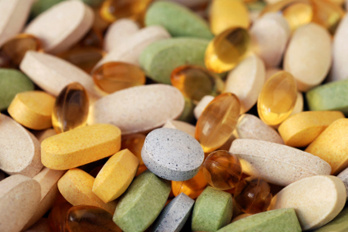
Most medical research suggests that vitamins are a good way to create expensive pee. Many of us take them anyway. Fifty-three percent of men swallow a multivitamin at least once a week, the same as the odds (1 in 1.89) that an adult drinks traditional coffee in a day. Even more women, 1 in 1.57 (64%), take their vitamins.
That’s almost exactly the odds an adult considers him- or herself to be a healthy eater (1 in 1.56)—and hopefully not because he or she has a tablespoonful of vitameatavegamin after every meal. Nutrition can come from a balanced diet, even more easily now (thanks to fortified food) than when Lucille Ball declared “The answer to all your problems is in this little bottle.”
It seems logical that multi-vitamins would be beneficial. Certainly, not having enough can be bad: vitamin C deficiency causes scurvy, vitamin D deficiency causes rickets. But having more than enough may not be better. The best randomized trials of the past few years have failed to show that adding nutritional supplements to a normal diet does anything to prevent heart disease, cancer, or death. One study even suggested antioxidants may shorten lives.
“We call them essential nutrients because they are,” Marian L. Neuhouser of the Fred Hutchinson Cancer Research Center, in Seattle, told the New York Times. “But there has been a leap into thinking that vitamins and minerals can prevent anything from fatigue to cancer to Alzheimer’s. That’s where the science didn’t pan out.”
Sales have not been affected by this news—or by the economy. Even as the stock market crashed, vitamin sales soared to a projected $9.2 billion in 2009. Some theories hold that patients, for lack of affordable health care, are seeing supplements instead of doctors. But it could be more benign than that. “Vitamins may work,” says Los Angeles lawyer David Illions, “and if they don’t, at least I’m giving myself a little kiss every time I take them.”