
In 2025, how many Americans in every 100,000 were murdered: about 4, about 40 or about 400, and how many of us worry about it?
About 4. The FBI estimates a murder rate of 4.1 per 100,000 people for 2025, about 1 in 24,000, tied with 1955 and 1956 for the lowest since its national estimates began (FBI, Reported Crimes in the Nation 2025).
That figure comes from the FBI’s national estimate (Crime in the United States, or CIUS, which combines Summary Reporting System data with NIBRS data converted to that format) for murder and nonnegligent manslaughter. It counts offenses known to police, estimated for the whole country, per 100,000 people in a year. The FBI’s report does not print a 2025 count, so the “about 1 in 24,000” is worked from the rate: 100,000 divided by 4.1. That is a lot of capital letters for one small number, even by the standards of a statistics bureau.
The drop, in the FBI’s words
The FBI estimates that the number of murders fell 18.1% from 2024 to 2025, and that the murder rate fell 18.5%. It says that is the largest year to year fall in its estimated murder rate since it began making national estimates in 1936. The report describes the change without giving a reason for it, and so does this page.
The worry side
Gallup asks Americans every October how often they worry about a list of crimes. In October 2025, 22% said they worry about getting murdered frequently or occasionally (8% frequently, 14% occasionally), about 1 in 5 adults. The poll was a random telephone sample of 1,000 adults, interviewed Oct. 1 to 16, 2025.
For scale, of the 10 crimes Gallup asked about, getting murdered ranks second lowest by the share who worry frequently or occasionally, just above being sexually assaulted (21%). Identity theft tops the list at 69%, and scammers come next at 53%.
The two headline numbers measure different things: one is a yearly rate, the other a share of adults at one moment. So this page sets them side by side and never divides one by the other.
Eleven years side by side

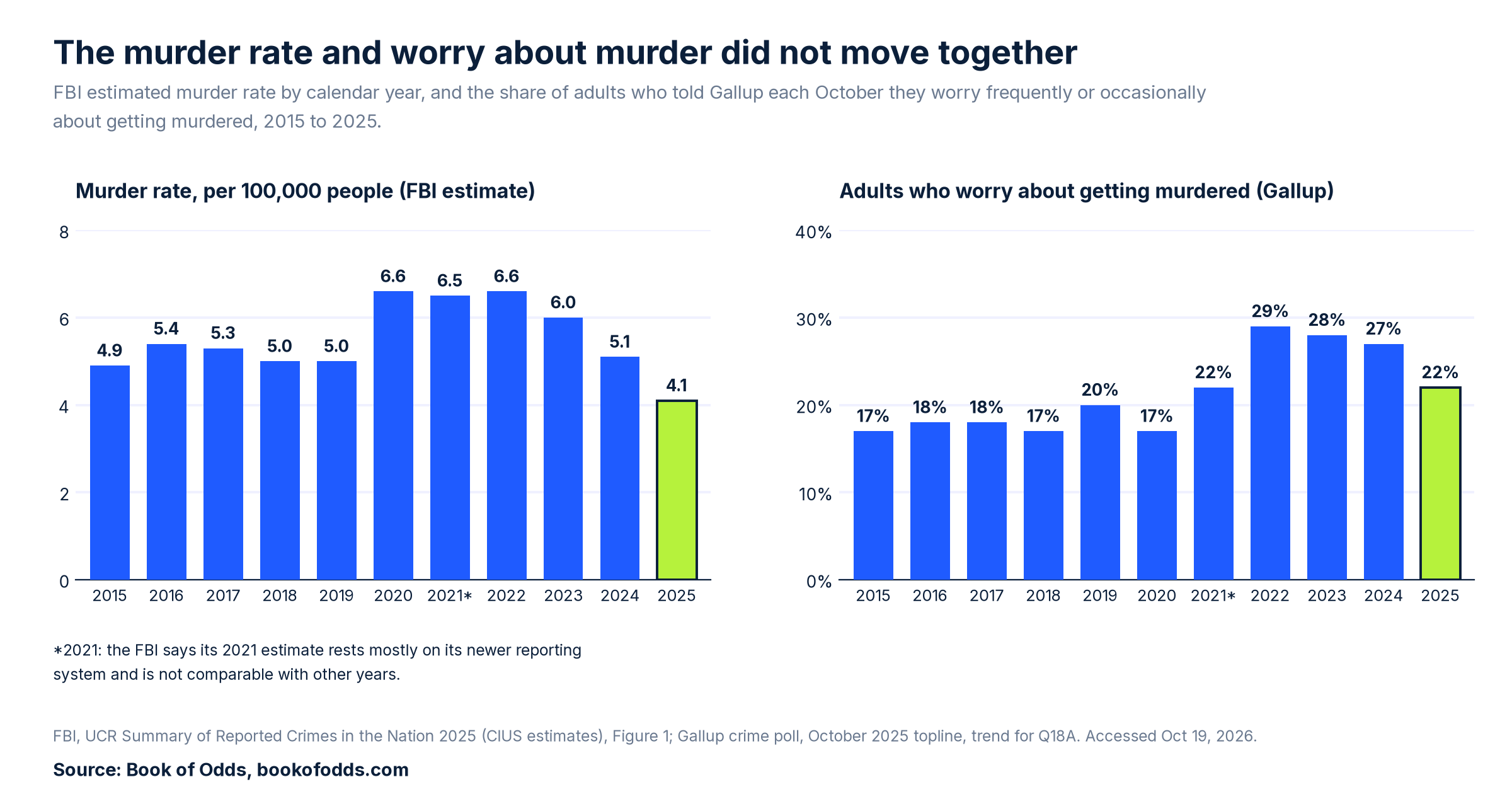
From 2015 to 2025, the murder rate and worry about murder did not rise and fall together. The FBI rate hit its 20 year high of 6.6 per 100,000 twice, in 2020 and in 2022. Worry about getting murdered was 17% in 2020 and 29% in 2022. In 2025 the rate was 4.1, the lowest in the FBI’s 20 year series, while worry, at 22%, was higher than in any year from 2015 to 2020. The Gallup shares in the chart are our sums of the frequently and occasionally figures.
One year carries a flag. The FBI says its 2021 estimate rests mostly on its newer reporting system, falls below the level it needs to represent the nation, and is not comparable with other years.
A second count, from 2024
This paragraph uses 2024 data and a different measure. CDC death certificates count 20,162 homicide deaths of US residents in 2024, a rate of 5.9 per 100,000. That is higher than the FBI’s estimate for the same year, 5.1 per 100,000. The two do not match because CDC counts deaths by the cause written on the death certificate, while the FBI estimates offenses known to police. CDC’s latest full year in this data is 2024, so its figure sits one year behind the FBI headline.
More crime than a year ago?
Gallup’s October 2025 poll also asked whether there is more crime in the US than a year earlier. 49% said more, down from 64% in 2024 and 77% in 2023. That question is about crime of every kind, asked during 2025, so it is reported here on its own.
Data limits
The FBI figure is an estimate of offenses known to police, built from agencies covering 96.2% of the population in 2025, and it is a yearly national average, not anyone’s personal risk. The FBI revises earlier years when it publishes a new report, so every FBI rate on this page comes from its 2025 report; few statistics edit their own back catalog so politely. The FBI and CDC count different things, offenses known to police and deaths by death certificate cause, and CDC’s latest year is 2024. The FBI says its 2021 estimate is not comparable with other years. The Gallup figure is a share of adults who say they worry, from one poll, a probability sample with a margin of plus or minus 4 points, so it cannot be turned into odds.
The short version
The FBI’s estimate puts the 2025 US murder rate at 4.1 per 100,000, about 1 in 24,000 a year, worked from that rate. Gallup’s October 2025 poll found that 22% of adults worry about getting murdered frequently or occasionally. Gallup’s October 2026 poll and the FBI’s next national estimate will update both halves, and this page will be rechecked against them.
Last checked: 2026-10-19, against the FBI’s UCR Summary of Reported Crimes in the Nation 2025, CDC WONDER and Gallup’s October 2025 crime poll. This article was machine-checked against the sources above and has not been expert-reviewed. Spotted an error or a newer public figure? Please tell us on our contact page with the article link and we will review it.
Sources
- S1 FBI Uniform Crime Reporting Program, “UCR Summary of Reported Crimes in the Nation, 2025” (released August 2026; data as of April 2, 2026), pp. 5 to 7, 9, 10 (Figure 1 and footnote 7) and 23. https://cde.ucr.cjis.gov/LATEST/resources/reports/UCR_Summary_of_Reported_Crimes_in_the_Nation_2025.pdf . Accessed Oct 19, 2026.
- S2 FBI, “FBI Releases 2025 Reported Crimes in the Nation Statistics”, press release, Aug 14, 2026. https://www.fbi.gov/news/press-releases/fbi-releases-2025-reported-crimes-in-the-nation-statistics . Accessed Oct 19, 2026.
- S3 CDC, National Center for Health Statistics, CDC WONDER, Underlying Cause of Death 2018 to 2024, Single Race, ICD-10 X85 to Y09 and Y87.1 (assault, homicide), by year. https://wonder.cdc.gov/ucd-icd10-expanded.html . Accessed Oct 19, 2026.
- S4 Gallup, “Crime in U.S. Seen as Less Serious for Second Straight Year”, Megan Brenan, Oct 30, 2025, https://news.gallup.com/poll/697124/crime-seen-less-serious-second-straight-year.aspx , and its topline, Q11, Q18 and Q18A; trends at https://news.gallup.com/poll/1603/crime.aspx . Accessed Oct 19, 2026.
- Method: the “1 in” odds, “about 1 in 5” and the Gallup trend sums are Book of Odds arithmetic. The “about 1 in 24,000” is worked from the FBI’s rounded rate of 4.1 per 100,000, not from a count.