

Of Americans who made a New Year’s resolution for 2019, how many said that December they had kept it for at least part of the year: about 1 in 4, about half or nearly 3 in 4?
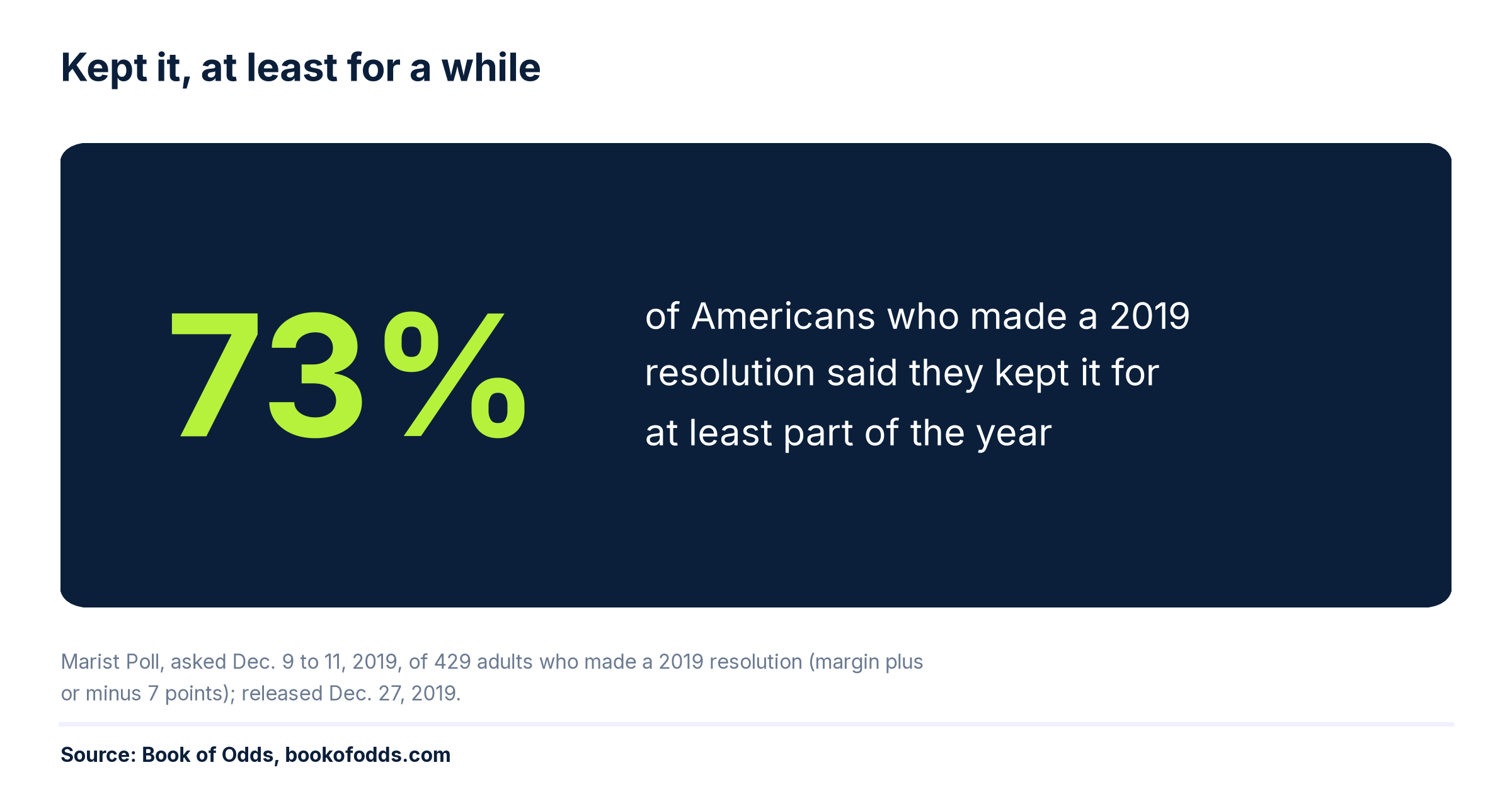
Nearly 3 in 4. In a Marist Poll released Dec. 27, 2019, 73% of Americans who made a resolution for 2019 said they kept it for at least part of the year.
“At least part of the year” is Marist’s bar, and a low one: the poll did not ask for how long. Even so, Marist called it the highest share since the question was first asked in 1995; for 2018 it was 68%. Men (79%) were more likely than women (67%) to say they kept their 2019 resolution.

Every “kept” figure on this page is what people said about their own resolutions, at a stated time, in a stated poll. “Made a resolution” is a different measure, asked of all adults. Pew Research Center and the Washington Post with SSRS use panels recruited by random sampling. Marist’s 2019 poll phoned 1,744 adults in the contiguous US, using live interviewers and randomly selected cell and landline numbers; its keeping figure comes from the 429 who had made a 2019 resolution. YouGov uses an opt-in online panel, and the Norcross studies followed small groups of resolvers. We do not treat them as one measure.
Where the 8% comes from
You may have read that only 8% of people keep their New Year’s resolutions. The earliest version we found is a December 2008 blog post by Stephen Shapiro, on a survey he says he ran with Opinion Corporation of Princeton: “Only 8% of people are always successful in achieving their resolutions.” That is a stricter bar than keeping one resolution (our inference), and the post gives no sample size or dates, so we could not check it. One widely copied statistics site credits the 8% to the University of Scranton and the Journal of Clinical Psychology. The Scranton group’s resolutions paper in that journal reports something else: at six months, 46% of the resolvers it followed were “continuously successful”. Its abstract has no 8%.
Less than a month in
Pew Research Center asked Jan. 16 to 21, 2024, less than a month into the year. Of Americans who made resolutions for 2024, 87% said they had kept at least some of them so far. Of those who made more than one resolution, 59% said they had kept all of them.
The longer view, from small studies
Two peer-reviewed studies by Norcross and colleagues followed small samples of resolvers, not a random sample of Americans. In the 2002 study, 46% of 159 resolvers were “continuously successful” at six months, compared with 4% of 123 nonresolvers. An earlier study, published in 1988, followed 200 resolvers for two years: 77% kept their pledges for one week, and 19% for two years. Both are old, small samples, not a share of all Americans.
How many make one
Pew Research Center asked US adults in January 2024 whether they had made any New Year’s resolutions that year, and 30% said yes. The Washington Post and SSRS asked the same question in January 2026, and 48% said yes. It is the same question, two years apart; the Post’s own results sheet prints Pew’s figure beside its own. The polls used different panels and asked at different points in January, and their published methods do not explain the gap. So these are two readings, not a trend, and we do not average them.
This year, from an opt-in panel
YouGov surveys an opt-in online panel of US adult citizens, and it asked Oct. 2 to 5, 2026. In that panel, 23% said they had made a New Year’s resolution or set a goal for 2026, a broader question than Pew’s or the Post’s. Of those, 65% said they had mostly or entirely stuck to it so far (our arithmetic: 15% entirely plus 50% mostly). Asked about other people, only 11% of all adults in the same opt-in panel thought resolvers had mostly or entirely stuck to theirs (our arithmetic: 2% plus 9%). Resolvers in that opt-in panel rated themselves far more kindly than the panel as a whole rated resolvers (our inference).
Data limits
Every keeping figure here is self-reported and was asked at a different point in the year, so together they are not one rate. The newest random-sample poll we found that asks about keeping a resolution across a year is Marist’s for 2019, and none we found has asked since. Marist gives its margin of error for those 429 people as plus or minus 7 percentage points. Pew and the Post asked the same question two years apart and got 30% and 48%, and their published methods do not explain the gap. YouGov is an opt-in online panel and the Norcross studies are small samples, so neither is a population estimate. The 8% traces to a 2008 blog post with no published survey method.
The short version
In a Marist Poll released Dec. 27, 2019, 73% of Americans who made a resolution for 2019 said they kept it for at least part of the year. Pew Research Center (January 2024) and the Washington Post with SSRS (January 2026) asked the same question about making one and got 30% and 48%, two readings, not a trend. The often repeated 8% traces to a 2008 blog post with no published survey method. A new December poll may update this page.
Last checked: 2026-10-19, against the Marist Poll, Pew Research Center, the Washington Post and SSRS, YouGov and the Norcross studies cited above. This article was machine-checked against the sources above and has not been expert-reviewed. Spotted an error or a newer public figure? Please tell us on our contact page with the article link and we will review it.
Sources
- S1 Marist Poll, “Health & Fitness Top New Year’s Resolutions… Americans Who Kept Resolution at Highest Point,” Dec. 27, 2019. https://maristpoll.marist.edu/wp-content/uploads/2019/12/Marist-Poll_New-Years-Resolutions_Written-Summary-of-Findings_1912201400.pdf . Accessed Oct 19, 2026. Method statement (“Nature of the Sample”) and national tables, interviews Dec. 9 to 11, 2019. https://maristpoll.marist.edu/wp-content/uploads/2019/12/Marist-Poll_New-Years_USA-NOS-and-Tables_1912180912.pdf . Accessed Oct 19, 2026.
- S2 Shanay Gracia, “New Year’s resolutions: Who makes them and why,” Pew Research Center, Jan. 29, 2024, and topline, American Trends Panel Wave 140, Jan. 16 to 21, 2024. https://www.pewresearch.org/short-reads/2024/01/29/new-years-resolutions-who-makes-them-and-why/ ; https://www.pewresearch.org/wp-content/uploads/2024/01/SR_24.01.29_resolutions_topline.pdf . Accessed Oct 19, 2026.
- S3 Scott Clement, Eric Lau and Shelly Tan, “We asked 1,000 Americans about their New Year’s resolutions,” Washington Post, Jan. 11, 2026, and topline, Washington Post poll by SSRS, Jan. 2 to 4, 2026. https://www.washingtonpost.com/wellness/interactive/2026/new-year-resolutions-poll-health-finances/ ; https://www.washingtonpost.com/documents/0da2c9af-16d5-4dc3-af43-552cc3eff7e8.pdf . Accessed Oct 19, 2026.
- S4 J. C. Norcross, M. S. Mrykalo and M. D. Blagys, “Auld lang syne: success predictors, change processes, and self-reported outcomes of New Year’s resolvers and nonresolvers,” Journal of Clinical Psychology 58(4), 397 to 405, 2002. https://doi.org/10.1002/jclp.1151 . Accessed Oct 19, 2026.
- S5 J. C. Norcross and D. J. Vangarelli, “The resolution solution: longitudinal examination of New Year’s change attempts,” Journal of Substance Abuse 1, 127 to 134, 1988. https://doi.org/10.1016/s0899-3289(88)80016-6 . Accessed Oct 19, 2026.
- S6 YouGov, “New Year’s Resolutions” survey results, Oct. 2 to 5, 2026, 1,053 US adult citizens, opt-in online panel. https://d3nkl3psvxxpe9.cloudfront.net/documents/New_Year_s_Resolutions_poll_results_AnZXtV7.pdf . Accessed Oct 19, 2026.
- S7 Statistic Brain, “New Years Resolution Statistics,” as captured by the Internet Archive on Oct. 28, 2016: where the 8% appears, cited only to show where it is credited, not as a source for it. https://web.archive.org/web/20161028212526/http:/www.statisticbrain.com/new-years-resolution-statistics/ . Accessed Oct 19, 2026.
- S8 Stephen Shapiro, “Interesting New Year’s Resolution Statistics,” December 2008, https://stephenshapiro.com/interesting-new-years-resolution-statistics/ . Accessed Oct 19, 2026.
- Method: each figure is the pollster’s or study’s published result for the group and date shown. The 65% and 11% from YouGov are Book of Odds sums of two published shares each. No figures from different polls are combined or averaged.