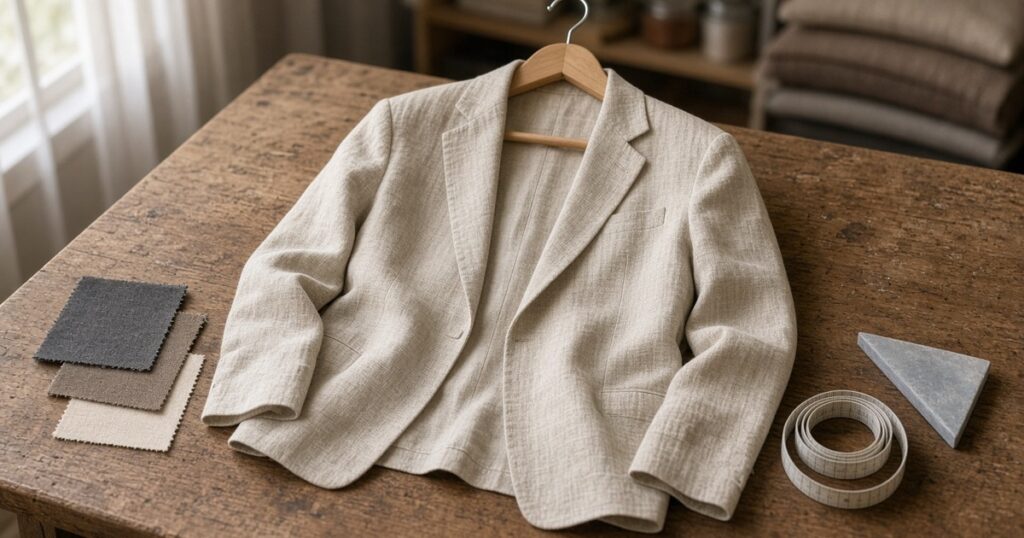

Which job is more common in the United States: fashion designer, athlete or actor?
Actor, by a lot: the Bureau of Labor Statistics counts about 67,500 actor jobs in 2025, against about 32,700 fashion designer jobs and about 22,900 athlete and sports competitor jobs.
Pick your version of the crowd
Imagine you are standing between a theater lobby and a stadium gate, holding a sketchbook. Three crowds are heading toward you, and you have to guess which is the biggest. The one in the middle is carrying fabric swatches. Make your pick before you read on.
The number that carries the piece: 32,700
BLS counts about 32,700 fashion designer jobs in the US in 2025. The figures here come from the BLS Employment Projections program, which counts jobs rather than people, and BLS rounds them to the nearest 100. So every job count below is “about”, and every ratio is approximate. Shares are as BLS prints them.
| Job | Jobs in the US, 2025 |
|---|---|
| Actors | about 67,500 |
| Fashion designers | about 32,700 |
| Athletes and sports competitors | about 22,900 |
Actors have about 2.1 times as many jobs as fashion designers (67,500 divided by 32,700 is 2.06, our arithmetic). For how careers sort people at work beyond job counts, see gender discrimination in the workplace.
The twist: fashion design has more jobs than the athlete category
Fashion designers have more jobs than athletes and sports competitors, about 1.4 to 1 (32,700 divided by 22,900 is 1.43, our arithmetic). The athlete category is the smaller one, though it is broad: team sports such as baseball, football, hockey and soccer, and individual sports such as golf, racecar driving and tennis.
Against all work in the country, fashion design is small. BLS counts 170,280.8 thousand jobs, or about 170.3 million, in the US economy in 2025. Divide 170,280,800 by 32,700 and fashion designer jobs come to about 1 in 5,200 US jobs, or 0.019 percent (our arithmetic). Imagine 5,200 seats in a stadium section, one seat for every US job. Scan the section and, on average, you will find one fashion designer job and the rest other jobs.
Two neighboring design jobs give the scale. BLS counts about 97,100 interior designer jobs, roughly three times the fashion designer count, and about 45,200 floral designer jobs, about 1.4 times as many (our arithmetic: 2.97 and 1.38). For body image pressure in fashion and film, see Hollywood’s Juicy Fruit, Starving on the Vine.

Who counts as a fashion designer
The BLS category is wider than the runway. It covers designers of clothing, footwear and accessories, and it includes costume designers for the performing arts, film and television.
Where and how they work
About 36 percent of fashion designer jobs are held by unincorporated self-employed workers, the biggest share among the employer groups BLS lists. Retail trade follows at 20 percent and apparel, piece goods and notions wholesalers at 16 percent. For comparison, 29 percent of athlete and sports competitor jobs and 23 percent of actor jobs are held by the self-employed, so fashion design has the highest self-employed share of the three, by our comparison of BLS’s printed figures. BLS also says most fashion designers work in New York and California.
The next decade
BLS projects fashion designer jobs to be flat from 2025 to 2035, from 32,700 to 32,800, with about 2,500 openings a year. BLS lists the change as 0 because the figures are rounded to the nearest 100. Most of those openings come from workers who move to other occupations or leave the labor force, not from growth. A projection is an estimate, not a promise, and the 2025 base-year figure may be revised.
What this does not tell you
BLS counts jobs, not people. For wage and salary work, a worker with two jobs can be counted twice, which BLS notes is different from a count of workers. BLS says part-time work is common for both actors and athletes, so not every job counted is a full-time position. This count does not say how many people want any of these jobs, and it does not compare pay. The occupation categories are BLS definitions, so “fashion designer” includes costume designers and “athlete” includes racecar drivers. BLS says some actors work as extras and some do voiceover.
So, which job?
Actor has the most jobs of the three. Fashion designers come second, at about 32,700 jobs, or about 1 in 5,200 US jobs, ahead of athletes and sports competitors.
Sources and method
- BLS, Occupational Outlook Handbook, Fashion Designers (page last modified Aug. 27, 2026), accessed Oct. 19, 2026: https://www.bls.gov/ooh/arts-and-design/fashion-designers.htm
- BLS, Occupational Outlook Handbook, Athletes and Sports Competitors (modified Aug. 27, 2026): https://www.bls.gov/ooh/entertainment-and-sports/athletes-and-sports-competitors.htm
- BLS, Occupational Outlook Handbook, Actors (modified Sept. 14, 2026): https://www.bls.gov/ooh/entertainment-and-sports/actors.htm
- BLS, Occupational Outlook Handbook, Interior Designers (modified Aug. 27, 2026): https://www.bls.gov/ooh/arts-and-design/interior-designers.htm
- BLS, Occupational Outlook Handbook, Floral Designers (modified Aug. 27, 2026): https://www.bls.gov/ooh/arts-and-design/floral-designers.htm
- BLS, Employment Projections, Table 1.1, employment by major occupational group: https://www.bls.gov/emp/tables/emp-by-major-occupational-group.htm
- BLS, Employment Projections data definitions: https://www.bls.gov/emp/documentation/definitions.htm
- BLS, Employment Projections methods overview: https://www.bls.gov/emp/documentation/projections-methods.htm
BLS pages accessed Oct. 19, 2026.
Method: all counts are 2025 jobs from BLS Employment Projections, rounded to the nearest 100, and the total is from the same program. The ratios and the 1-in-5,200 figure are our arithmetic; the 36, 29, 23, 20 and 16 percent shares are BLS’s printed figures. 67,500 divided by 32,700 is 2.06. 32,700 divided by 22,900 is 1.43. 170,280,800 divided by 32,700 is 5,207, so about 1 in 5,200. 97,100 divided by 32,700 is 2.97. 45,200 divided by 32,700 is 1.38.
Last checked and corrections
Last checked: 2026-10-19. This article was machine-checked against the sources above and has not been expert-reviewed. Spotted an error or a newer public figure? Please tell us on our contact page with the article link and we will review it.