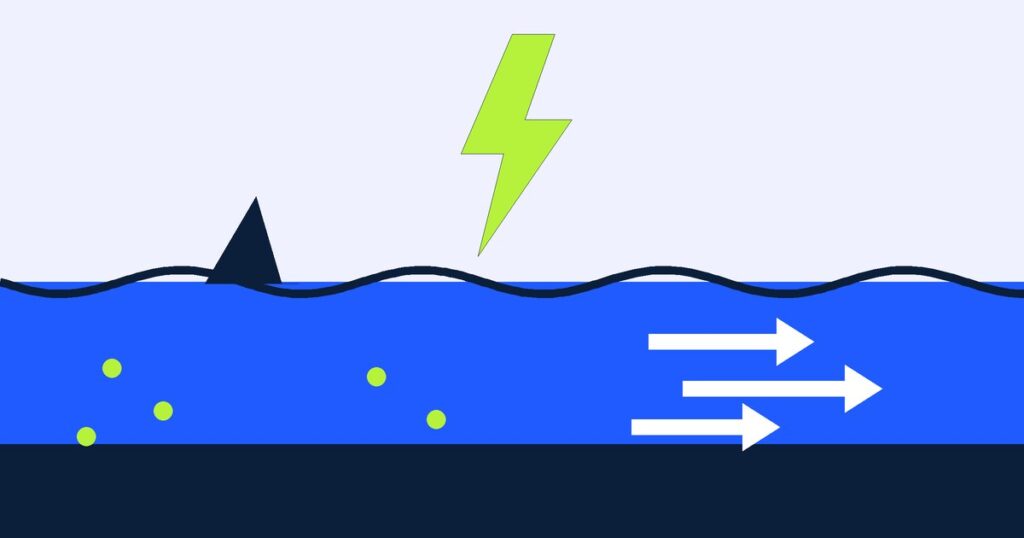
Which kills more people in the United States: a shark, lightning or a rip current?
A rip current, by a wide margin, in both 2024 and 2025. The National Weather Service (NWS) counted 55 rip current deaths in 2025, against 20 for lightning. The International Shark Attack File (ISAF) counted 1 death from an unprovoked shark bite in the US that year, and 1 in 2024.
Place your bet
Imagine you are standing on a beach at noon. Three signs are stuck in the sand, one for each hazard, and you must pick the one to worry about most before you take another step. The shark sign is the one with the best poster. Make your pick before you read on.
The number that carries the piece: 55
Three sources, three different record keepers, so the basis comes first. Each cell below is deaths in the US in one calendar year.
| Hazard | 2025 | 2024 | Who counts it, and what counts |
|---|---|---|---|
| Rip current | 55 | 74 | NWS Storm Data, from forecast offices in the 50 states, Puerto Rico, Guam and the Virgin Islands; includes the Great Lakes; forecasters judge which drownings are rip currents |
| Lightning | 20 | 14 | NWS Storm Data, same coverage. (The NWS lightning fatality page, which counts direct deaths only, lists 21 for 2025 and is preliminary.) |
| Shark | 1 | 1 | ISAF, unprovoked bites only; the US 2025 table shows 25 bites, 1 fatal, with Puerto Rico listed separately. The 2024 fatality is from the ISAF research news item “Unprovoked shark bites plummeted in 2024” |
The 2025 figures are the NWS’s preliminary numbers. In 2025, then, rip currents killed 55 people for every 1 killed by an unprovoked shark bite, and 2.75 times as many as lightning (our arithmetic, from the table above).
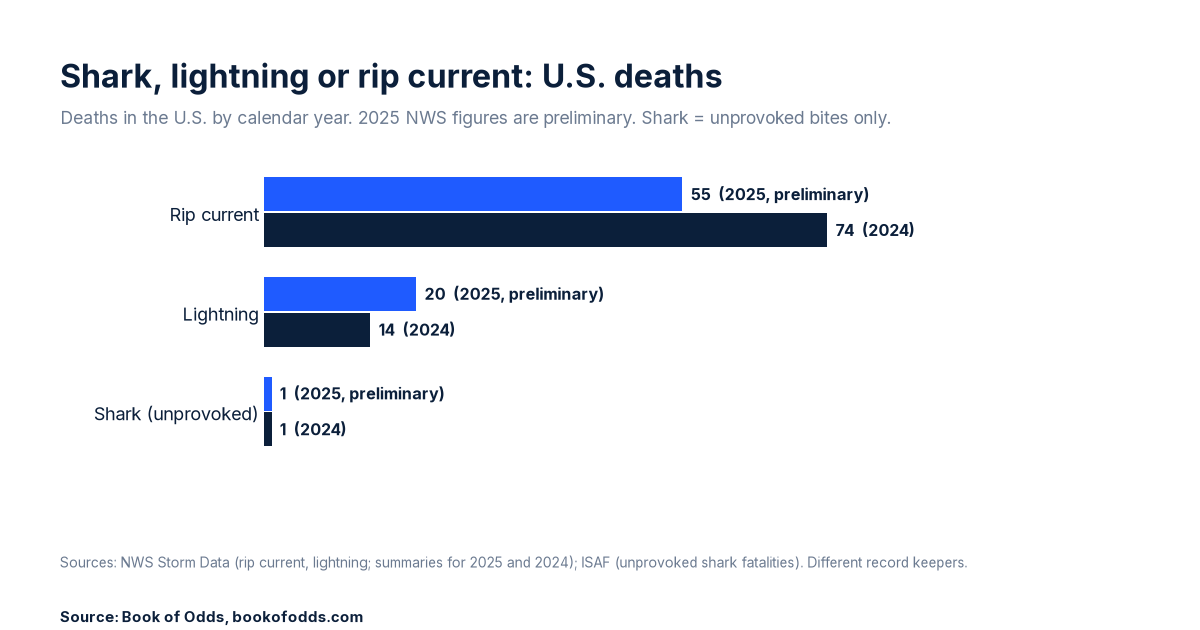
Be wary of those sharks. Two years of one death each is a small sample, and the ISAF itself says annual fluctuations are expected. The ISAF’s research news item “Unprovoked shark bites plummeted in 2024” says the attack off northwest Oahu, Hawaii, “resulted in the only unprovoked fatality in the U.S.” that year, so 2024 is 1. Put together, rip currents killed 129 people in 2024 and 2025 (74 plus 55), lightning 34 (14 plus 20) and unprovoked sharks 2 (1 plus 1), all our arithmetic from the table above.
The twist: the quiet one
The hazard with the least drama is the one that wins. The NWS says rip currents often form on calm, sunny days, which is also when people go to the beach. On the NWS table, rip currents ran at 76 deaths a year on average over 2015 to 2024 (the table’s 10-year average). Lightning averaged 20 over the same ten years. Both are the NWS’s figures. We recomputed the sums from the yearly rows: 757 rip current deaths in ten years, 75.7 a year; 196 lightning deaths, 19.6 a year (our arithmetic).
The human-scale comparison
Here is the version for the beach towel. In 2025 the US had 25 confirmed unprovoked shark bites, according to the ISAF, and one of them was fatal. In the same year the NWS counted 55 rip current deaths. If you were choosing which sign to read twice, the NWS counts say the sign about the water is the one that earned it. A shark is the headline, and the headline is not the number.
What this does not tell you
*Deaths, not risk.* These are counts of deaths, not odds per swimmer. Nothing here adjusts for how many people entered the water, stood outdoors in a storm or went to a particular beach.
*The three counts are not built the same way.* The NWS counts come from Storm Data, and a rip current death there is a judgment call. Under NWS Instruction 10-1605, a rip current is listed in Storm Data when it causes a drowning, a near-drowning or one or more rescues, or damages watercraft; the count includes the Great Lakes, and the NWS summaries say it covers the territories; and the Storm Data preparer exercises professional judgment on whether a death was a rip current. The ISAF counts only unprovoked bites: bites on a live human in the shark’s natural habitat with no human provocation. Provoked bites and other cases are separate in its table. Lightning’s NWS summary figure for 2025 is 20 and the NWS lightning fatality page lists 21, a one-death difference we do not resolve.
*NWS has a second rip current count, and it is lower.* The NWS also keeps preliminary surf zone fatality lists. For 2025 that list shows 99 surf zone deaths, 47 of them marked rip current, against 55 in Storm Data. For 2024 it shows 63 surf zone deaths, 59 of them marked rip current, against 74 in Storm Data. The NWS says these data “may not match other sources,” and we have not reconciled the two. The ordering does not depend on which count you pick: even the lower figures, 47 and 59, are well above lightning (20 and 14) and sharks (1 and 1).
*Sharks are measured on a thin sample.* One fatality in each of two years is a small number, and the ISAF reports a worldwide five-year average of eight unprovoked fatalities a year, a global figure we do not convert to a US average.
*Preliminary and partial years.* The 2025 NWS figures are preliminary. The NWS lightning page notes that its own data is preliminary and refers to Storm Data for official data.
Back to the three signs
Rip current: 55 deaths in the US in 2025, in the NWS Storm Data count (47 on the NWS surf zone list). Lightning is next at 20, and the shark, at 1, takes the sign with the best poster.
Related on Book of Odds: Sharks or vending machines, which is deadlier?
Sources and method
- NWS, Summary of Natural Hazard Statistics for 2025 in the United States (preliminary, report generated July 8, 2026), accessed October 18, 2026: https://www.weather.gov/media/hazstat/sum25.pdf
- NWS, Summary of Natural Hazard Statistics for 2024 in the United States (report generated March 24, 2026), accessed October 18, 2026: https://www.weather.gov/media/hazstat/sum24.pdf
- NWS, 80-Year List of Severe Weather Fatalities (through 2024, with 10-year average), accessed October 18, 2026: https://www.weather.gov/media/hazstat/80year_2024.pdf
- NWS, Lightning fatalities page (statistics courtesy of the National Lightning Safety Council; preliminary), accessed October 18, 2026: https://www.weather.gov/safety/lightning-fatalities
- NWS, How to Avoid Getting Caught in a Rip Current, accessed October 18, 2026: https://www.weather.gov/safety/ripcurrent
- Florida Museum, International Shark Attack File, Yearly Worldwide Shark Attack Summary (2025), accessed October 18, 2026: https://www.floridamuseum.ufl.edu/shark-attacks/yearly-worldwide-summary/
- Florida Museum research news, “Unprovoked shark bites plummeted in 2024” (February 11, 2025), accessed October 18, 2026: https://www.floridamuseum.ufl.edu/science/unprovoked-shark-bites-plummeted-in-2024/
- NWS, Surf Zone Fatalities in the United States in 2025 and in 2024 (preliminary lists), accessed October 18, 2026: https://www.weather.gov/safety/ripcurrent-fatalities-25 and https://www.weather.gov/safety/ripcurrent-fatalities-24
- NWS Instruction 10-1605, Storm Data Preparation (July 26, 2021), rip current definition, Appendix A-60: https://www.weather.gov/media/directives/010_pdfs/pd01016005curr.pdf
Method: all death counts are the sources’ own. Our arithmetic: 55 divided by 1 and 55 divided by 20 (2.75), 74 plus 55, 14 plus 20, 1 plus 1, the count of rip-marked rows in the two NWS surf zone lists (47 of 99 and 59 of 63), and the 10-year sums for rip current (757) and lightning (196).
Last checked and corrections
Last checked: October 18, 2026. This article was machine-checked against the sources above and has not been expert-reviewed. Spotted an error or a newer public figure? Please tell us on our contact page with the article link and we will review it.