
How long did the shortest nine-inning game in major league history take: 51 minutes, about 75 minutes or about 90 minutes?
51 minutes, for a nine-inning game. On Sept. 28, 1919, the New York Giants beat the Philadelphia Phillies 6 to 1 at the Polo Grounds in the first game of a doubleheader, and both Baseball-Reference and Retrosheet record the time as 51 minutes.
A note on what “shortest” means here. This page counts two separate records from two separate games: the shortest nine-inning major league game by the time of game recorded in the box score, and the fewest pitches thrown by one pitcher in a nine-inning complete game. Games stopped early can be shorter still: Baseball-Reference records 35 minutes for a five-inning game on June 14, 1904, a 4 to 0 Philadelphia Athletics win at Cleveland, and MLB.com lists it as tied for the fastest official game on record. Then it works out, from the rules alone, how few pitches a game could take in theory.
How it went so fast
The two teams made 51 outs in 51 minutes, with 70 plate appearances between them, which SABR calls the fastest nine-inning game in major league history. That is about 44 seconds per plate appearance, with everything else included. The Giants never batted in the ninth, because they were already ahead.
Was it a deliberate race? The 1919 papers did not agree. The Illustrated Daily News wrote that both clubs “agreed to go after the speed record,” while the New York Times saw “no unusual effort” to set one until the Phillies’ half of the ninth. SABR still listed it as the fastest nine-inning game in major league history in 2022.
The fewest pitches
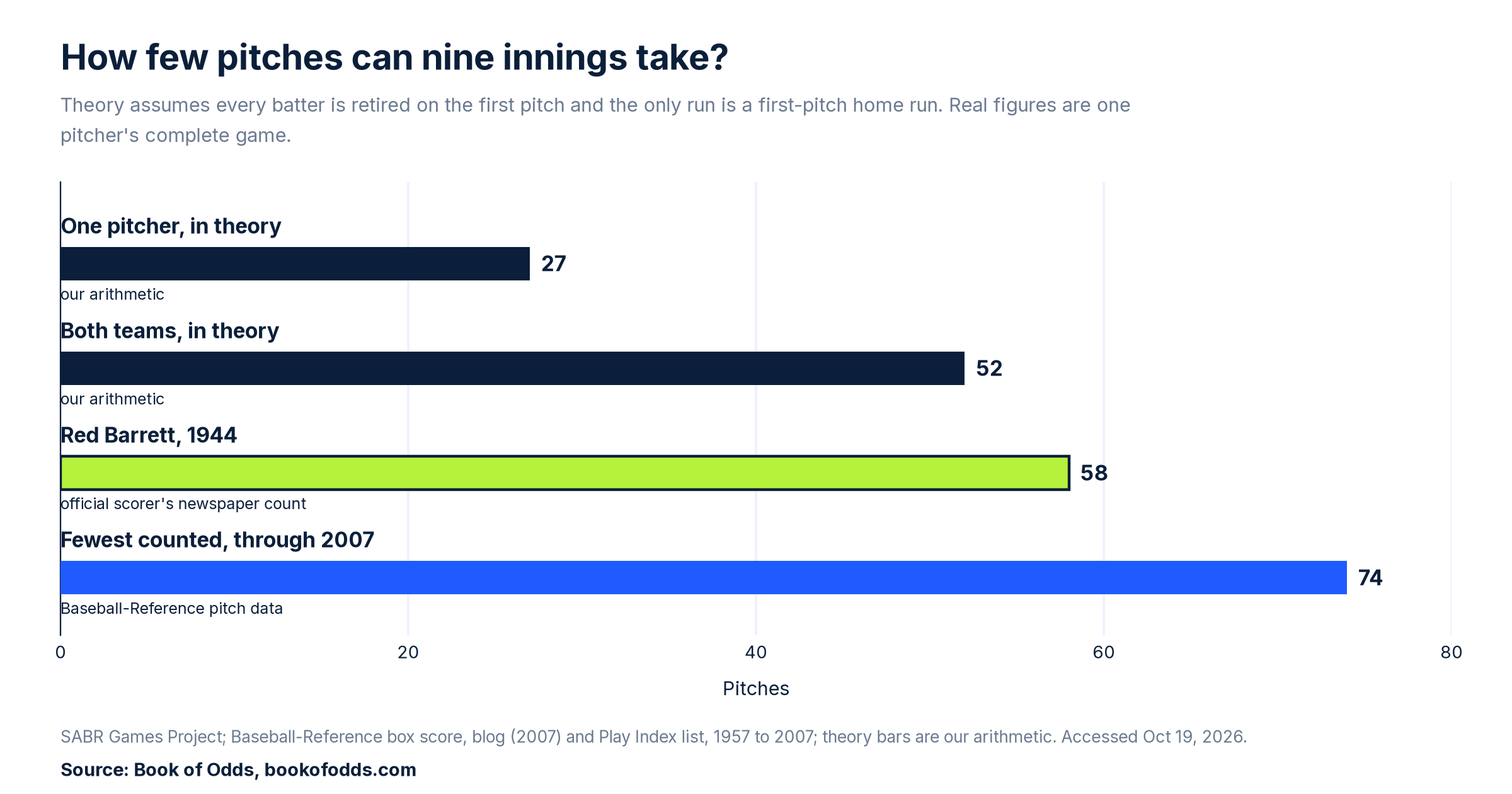
The fastest game was not the cheapest one. Red Barrett of the Boston Braves needed 58 pitches to shut out the Cincinnati Reds 2 to 0 on Aug. 10, 1944, allowing two hits, no walks and no strikeouts. That game still took 1 hour 15 minutes, 24 minutes longer than the 1919 game.
The 58 needs a label. It is the count of the game’s official scorer, Frank Grayson, reported in his newspaper, the Cincinnati Times-Star. Box scores from the 1940s carry no pitch counts, because nobody routinely recorded them, and SABR notes that the number “has not been challenged.”

The counted era
In Baseball-Reference’s pitch data, which is incomplete for older games, the fewest pitches in a nine-inning complete game through 2007 is 74, by Carlos Silva of the Twins in 2005, matched by Aaron Cook on July 25, 2007.
There is an older footnote, too. A 1919 paper, the New York American, counted 64 pitches for the Giants’ Jesse Barnes in the 51 minute game.
The thought experiment
How low could it go? Assume every batter is retired on the first pitch he sees, every out comes from a ball put in play, the game’s only run is a first-pitch home run, and the game lasts exactly nine innings.
One pitcher first. Nine innings need 27 outs, so a pitcher who works the whole game needs at least 27 pitches. SABR makes the same point: one could pitch a complete game with 27 pitches, “but no one has ever come close.”
Now both teams. The cheapest result is a 1 to 0 home win, because the home team then makes only 24 outs. The home pitcher throws 27 pitches for 27 outs. The visiting pitcher gets 24 outs in eight innings on 24 pitches, then throws one more that leaves the park. That makes 27 plus 25, or 52 pitches for the whole game. No other result costs less: a first-pitch walk-off home run in the bottom of the ninth also comes to 52, and a 1 to 0 road win costs 55. The hypothetical hitters, it should be said, swing at every first pitch and put every one in play, a level of cooperation no real lineup has offered.
Reality is a long way off. Barrett’s 58 is 31 pitches above the one pitcher floor. No documented complete game comes anywhere near 27, and no source keeps a record of the fewest combined pitches by both teams.
Other sports, briefly
Tennis: Jarkko Nieminen beat Bernard Tomic 6 to 0, 6 to 1 in Miami in 2014 in 28 minutes 20 seconds, which BBC Sport reported as the shortest ATP Tour match since records began in 1991.
Golf: Guinness World Records lists 27 minutes 9 seconds for 18 holes by James Carvill at Warrenpoint Golf Course in County Down on June 18, 1987, a solo speed round rather than a competitive game.
Data limits
Times of game are the figures recorded in the box scores; one 1919 headline said 50 minutes, but the box scores say 51. Pitch counts were not routinely kept in the 1940s, so Barrett’s 58 is one scorer’s count, printed in his newspaper and, SABR notes, not challenged, not an official box score figure. The 74 comes from Baseball-Reference data that ends, for this list, in 2007 and is incomplete for older games. The 27 and the 52 are our arithmetic under the stated assumption, not records. The tennis mark is the ATP’s since 1991 as reported in 2014, and the golf mark is a solo speed round, not a match.
The short version
The shortest nine-inning major league game took 51 minutes, a 6 to 1 Giants win over the Phillies on Sept. 28, 1919. The fewest pitches by one pitcher is Red Barrett’s 58 in 1944, by a newspaper count, against 27 in our thought experiment.
Last checked: 2026-10-19, against Baseball-Reference and Retrosheet box scores, the SABR Games Project, MLB.com, BBC Sport (2014) and Guinness World Records. This article was machine-checked against the sources above and has not been expert-reviewed. Spotted an error or a newer public figure? Please tell us on our contact page with the article link and we will review it.
Sources
- S1 Baseball-Reference box scores: Philadelphia Phillies vs New York Giants, Sept. 28, 1919 (game 1); Boston Braves at Cincinnati Reds, Aug. 10, 1944. https://www.baseball-reference.com/boxes/NY1/NY1191909281.shtml and https://www.baseball-reference.com/boxes/CIN/CIN194408100.shtml; Philadelphia Athletics at Cleveland, June 14, 1904, https://www.baseball-reference.com/boxes/CLE/CLE190406140.shtml . Accessed Oct 19, 2026.
- S2 Retrosheet box score, Sept. 28, 1919. https://www.retrosheet.org/boxesetc/1919/B09281NY11919.htm . Accessed Oct 19, 2026.
- S3 SABR Games Project, Stephen Ginader, “September 28, 1919: Giants and Phillies record 51 outs in 51 minutes, the fastest game in major-league history,” Nov. 1, 2022. https://sabr.org/gamesproj/game/september-28-1919-giants-and-phillies-record-51-outs-in-51-minutes-the-fastest-game-in-major-league-history/ . Accessed Oct 19, 2026.
- S4 SABR Games Project, “August 10, 1944: Braves’ Red Barrett shuts out Reds with record-low 58 pitches,” March 24, 2020. https://sabr.org/gamesproj/game/august-10-1944-braves-red-barrett-shuts-out-reds-with-record-low-58-pitches/ . Accessed Oct 19, 2026.
- S5 Baseball-Reference Blog, “Fewest pitches in a CG,” July 26, 2007, and Play Index list, complete games 1957 to 2007 sorted by fewest pitches. https://www.baseball-reference.com/blog/archives/111.html and https://www.baseball-reference.com/tools/share.fcgi?id=ptUB . Accessed Oct 19, 2026.
- S6 Frank Jackson, “Pitchers as efficiency experts,” The Hardball Times, Oct. 23, 2015, via SABR. https://sabr.org/latest/jackson-pitchers-as-efficiency-experts/ . Accessed Oct 19, 2026.
- S7 BBC Sport, “Jarkko Nieminen breaks Greg Rusedski’s fastest win record,” March 21, 2014. https://www.bbc.com/sport/tennis/26676844 . Accessed Oct 19, 2026.
- S8 Guinness World Records, “Fastest round of golf (individual).” https://guinnessworldrecords.com/world-records/64167-fastest-round-of-golf-individual . Accessed Oct 19, 2026.
- S9 MLB.com, “Fastest MLB games in history.” https://www.mlb.com/news/fastest-mlb-games-in-history . Accessed Oct 19, 2026.
- Method: the 27 and 52 pitch figures, the 31 pitch gap, the 24 minute difference and the seconds per plate appearance are Book of Odds arithmetic from the sources and the rules above.