
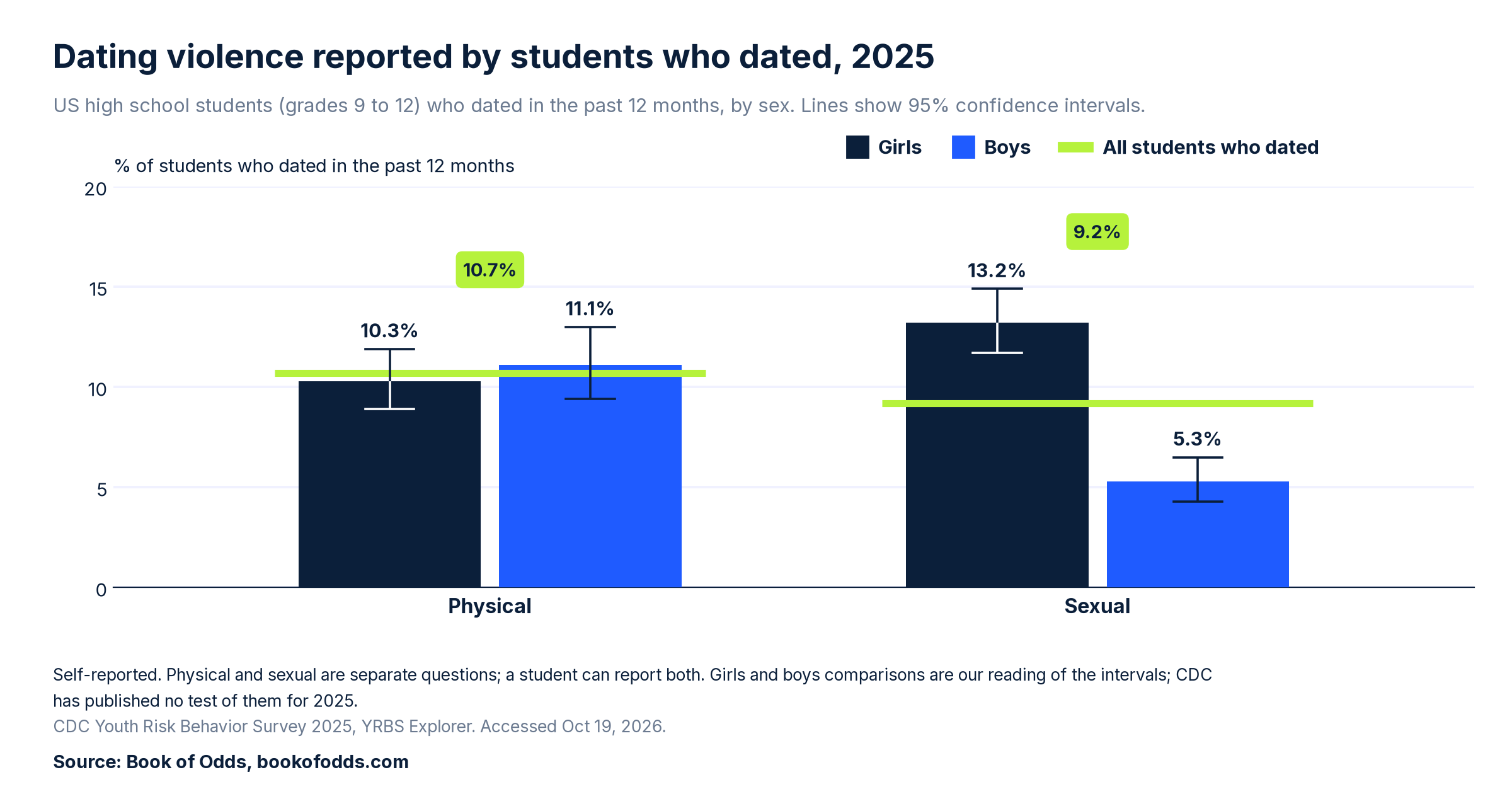
About 1 in 9 US high school students who dated said a dating partner had physically hurt them on purpose. In CDC’s 2025 Youth Risk Behavior Survey, 10.7% of US high school students who had dated in the past year gave that answer.
That share is not of all high school students. Its base is students in grades 9 to 12 who said they had dated or gone out with someone in the 12 months before the survey. Students who had not dated are left out of the count, and every student figure on this page is what students reported about themselves.
Physical and sexual dating violence are two separate questions, and a student can report both, so the two figures are never added together. A short section near the end covers adults, from a different CDC survey that cannot be compared with the student figures.
Girls and boys: physical dating violence
Among US high school students who dated, 10.3% of girls and 11.1% of boys reported physical dating violence in the 2025 survey. The survey’s margins of error for the two figures overlap, so the data show no measurable difference by sex (our inference).
Sexual dating violence
In the same 2025 survey, 9.2% of US high school students who dated, about 1 in 11, said someone they were dating had forced them to do sexual things they did not want to do. Among students who dated, that was 13.2% of girls (about 1 in 8) and 5.3% of boys (about 1 in 19). The rate for girls who dated is about two and a half times the rate for boys who dated (our arithmetic). The margins of error do not overlap, so the gap is larger than the survey’s error alone would explain (our inference); CDC has published no test of it.

How the survey asks
The physical question asks: “During the past 12 months, how many times did someone you were dating or going out with physically hurt you on purpose?” It tells students to count “such things as being hit, slammed into something, or injured with an object or weapon.” The sexual question asks how many times a dating partner made them do sexual things they did not want to do, counting “such things as kissing, touching, or being physically forced to have sexual intercourse.” Any answer of one or more times counts.
The national survey covers students in grades 9 to 12 at US public and private schools, including parochial schools, in the 50 states and the District of Columbia, and it runs in the spring of odd-numbered years.
CDC changed these questions in 2013, so figures from earlier surveys cannot be compared with these. Across the seven surveys from 2013 to 2025, among students who dated, the physical figure ranged from 8.0% to 10.7% and the sexual figure from 5.9% to 10.6%. CDC’s own trend analysis in YRBS Explorer reports the same pattern for both measures: no overall change from 2013 to 2025, a decrease from 2013 to 2017 and an increase from 2017 to 2025. CDC has not published a test of the change from 2023 to 2025 alone, so we do not say whether either figure rose or fell between those two surveys.
Where the 2025 figures come from
CDC has not published a 2025 report on dating violence; the figures here come from its YRBS Explorer data tool.
Adults: a different survey
CDC’s National Intimate Partner and Sexual Violence Survey (NISVS) asked US adults about their whole lives, with data collected in 2023/2024. More than 1 in 3 US women (34.0%) and more than 1 in 6 US men (17.0%) reported contact sexual violence, physical violence or stalking by an intimate partner during their lifetime. In that survey, an intimate partner can be a current or former spouse, boyfriend or girlfriend, or someone the person dated, was seeing or “hooked up” with.
CDC cautions readers “against comparing the findings in this report to NISVS findings from previous data years.” These adult, lifetime figures also cannot be compared with the student figures above, which cover students who dated and the past 12 months only.
Data limits
The student figures are self-reported answers from students in grades 9 to 12 at US public and private schools who dated in the past year; homeschooled students and young people not in school are not included. The 2025 survey’s overall response rate was 30.6%, the lowest in its history, and the survey has been taken on tablets since 2023. The questions changed in 2013, so earlier figures are not comparable, and CDC’s trend statement covers 2013 to 2025 as a whole; CDC has not published a test of the change from 2023 to 2025 alone. The girls and boys comparisons are our reading of the survey’s margins, not a CDC test. The adult figures come from a different survey with a 16.5% response rate, count lifetime experiences, and cannot be compared with earlier NISVS years or with the student figures.
The short version
In CDC’s 2025 Youth Risk Behavior Survey, about 1 in 9 US high school students who dated (10.7%) said a dating partner had physically hurt them on purpose, and 9.2% of students who dated reported sexual dating violence. A CDC report or test on the 2025 data may update this page.
If you want to talk about a relationship, love is respect lists two ways to reach it on its site: call 866-331-9474 or text LOVEIS to 22522. loveisrespect.org
Last checked: 2026-10-19, against CDC’s Youth Risk Behavior Survey (YRBS Explorer and the 2025 methods report) and CDC’s National Intimate Partner and Sexual Violence Survey, 2023/2024. This article was machine-checked against the sources above and has not been expert-reviewed. Spotted an error or a newer public figure? Please tell us on our contact page with the article link and we will review it.
Sources
- S1 CDC, YRBS Explorer, national high school results, United States, physical dating violence and sexual dating violence, 2025 and 2013 to 2023 (data read through the tool’s public API). https://yrbs-explorer.services.cdc.gov/ . Accessed Oct 19, 2026.
- S2 “Overview and Methods for the Youth Risk Behavior Surveillance System, United States, 2025,” MMWR Supplement 2026;75(1), Oct. 15, 2026, doi 10.15585/mmwr.su7501a1. https://doi.org/10.15585/mmwr.su7501a1 . Accessed Oct 19, 2026.
- S3 CDC, “2025 YRBS Data User’s Guide,” September 2026. https://www.cdc.gov/yrbs/files/2025/2025-YRBS-Data-Users-Guide-Final.pdf . Accessed Oct 19, 2026.
- S4 “Youth Risk Behavior Surveillance, United States, 2013,” MMWR 2014;63(SS-4), for the 2013 question change only. https://www.cdc.gov/mmwr/preview/mmwrhtml/ss6304a1.htm . Accessed Oct 19, 2026.
- S5 H. Zhang Kudon, S. Zhu, B. Chen, M. J. Breiding, R. W. Leemis, X. Zhang, A. Schwank and K. C. Basile, “The National Intimate Partner and Sexual Violence Survey (NISVS): 2023/2024 Intimate Partner Violence Data Brief,” CDC, February 2026. https://www.cdc.gov/nisvs/media/pdfs/intimatepartnerviolence-brief.pdf . Accessed Oct 19, 2026.
- S6 love is respect, home page. https://www.loveisrespect.org/ . Accessed Oct 19, 2026.
- Method: every student figure is a CDC weighted survey estimate for US high school students who dated in the past 12 months. The “about 1 in N” figures, the 2013 to 2025 ranges, the comparison of girls and boys and “about two and a half times” are Book of Odds arithmetic from CDC’s published estimates and margins of error.