

What share of ever-married Americans say they have had sex with someone other than their spouse while married: about 1 in 20, about 1 in 7 or about 1 in 3?
About 1 in 7. In the 2022 General Social Survey, run by NORC, 15.2% of ever-married adults said yes.
That figure is our weighted tabulation of NORC’s public data file, using the weight NORC recommends. The base is ever-married US adults who answered yes or no, 1,055 people in 2022.
What the question covers
The survey asks, word for word: “Have you ever had sex with someone other than your husband or wife while you were married?” It sits in the survey’s High Risk Behaviors module, which was developed by the Centers for Disease Control and Prevention and is self-administered, so people mark their own answers.
Three things follow from the wording. It is about sex, not emotional affairs or flirting. It counts only marriages, not dating or living together. And it is lifetime: “ever,” while married, not “this year.” So 15.2% is not a yearly rate of anything; it is the share of ever-married adults who say it has happened at some point. The word “ever,” it turns out, does a lot of quiet work.
Men and women
Across the survey years 2010 to 2018 combined, ever-married men said yes more often than ever-married women: 19.9% against 12.3%. That gap is far larger than the margin of error.
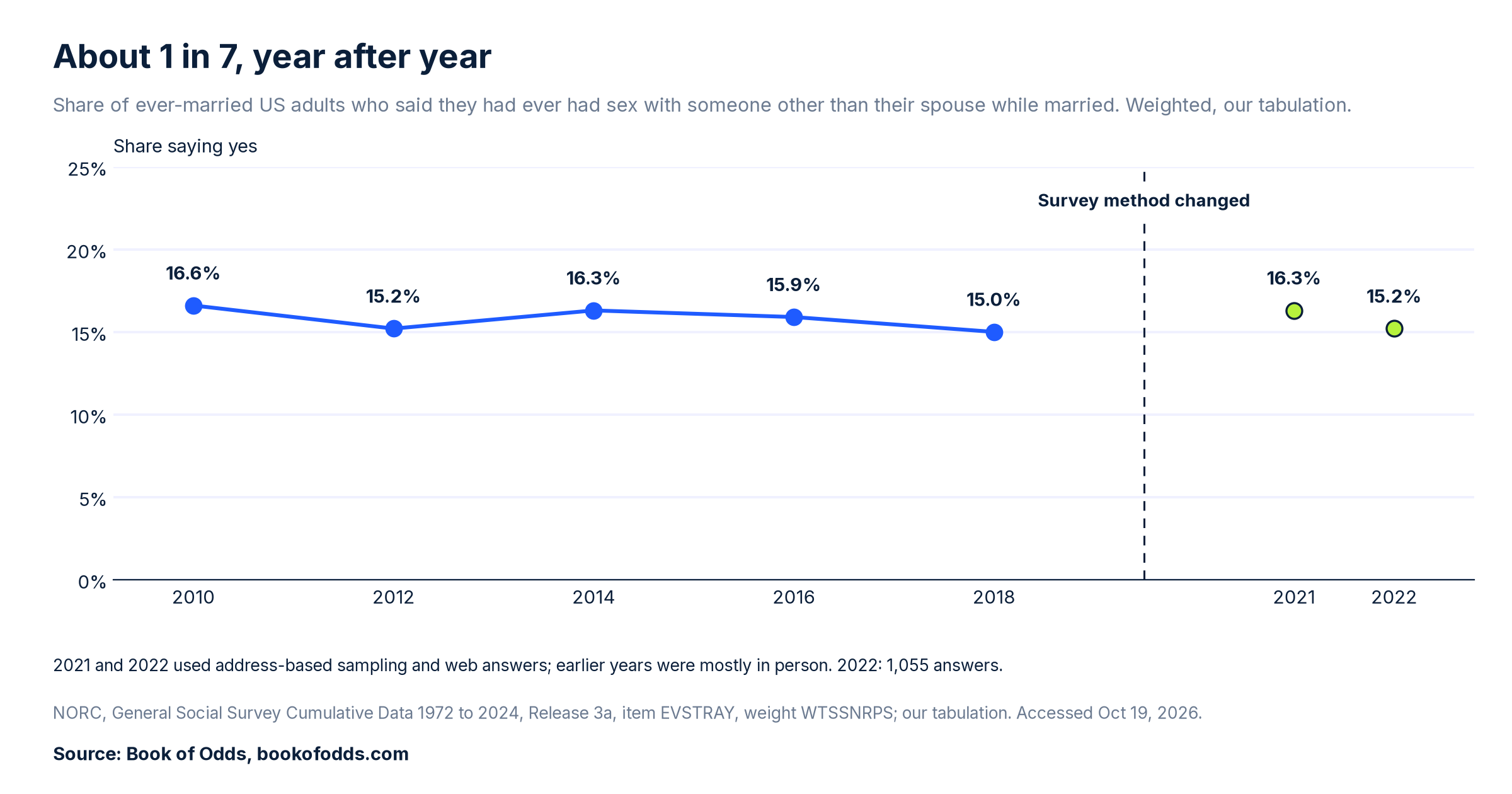
In 2022 the figures were 15.9% for men and 14.7% for women. That 1.2 point difference is not statistically significant: with this sample, each figure carries a margin of about 5 points, so the survey cannot tell the two apart. In 2021 and 2022 the survey also changed how it found and asked people, moving to address-based sampling and web answers. The question was self-administered both before and after, but the sample and the share answering online changed. That may explain part of the difference from the earlier years, along with ordinary sampling noise or a real shift; the data cannot say which.
Age
The share rises with age. In 2022, 12.2% of ever-married adults aged 35 to 49 said yes, against 16.9% at 50 to 64 and 21.8% at 65 and older. Among those aged 18 to 34, only 6 of the 116 who answered said yes, too few for a reliable share.
Read that as a lifetime measure. Older respondents have usually been married longer, so “ever” covers more years in which a yes could happen. It is not evidence that older people stray more now, or that younger ones are more faithful. After weighting, those 116 answers count like about 44, so the true share for that age group could be anywhere from under 1% to about 12%.
Steady, year after year
The overall share has hardly moved. In every survey year from 2010 to 2022, between 15.0% and 16.6% of ever-married adults said yes. That is a range, not a trend: 2010 was the high year and 2018 the low one.

As a cross-check, an Institute for Family Studies analysis of the GSS, published in 2018, reported that 20% of men and 13% of women said yes, close to the figures for 2010 to 2018 combined.
Data limits
These are self-reported answers to one lifetime question on a self-administered questionnaire; people may under-report something this sensitive, and no saved source measures by how much. The question was asked of only part of the 2022 sample, so the 2022 group is 1,055 answers, and after weighting it behaves like a simple random sample of about 431; the margins quoted here are approximate. In 2021 and 2022 the survey moved to address-based sampling and web answers, so comparisons with earlier years carry that caveat. The latest public data are from 2022: NORC lists the question for 2024, but 2024 answers are not in the public files. Every share here is our tabulation of NORC’s public data with NORC’s recommended weight.
The short version
About 1 in 7 ever-married US adults, 15.2%, told the 2022 General Social Survey they had had sex with someone other than their spouse while married. Men led women clearly across 2010 to 2018; the 2022 gap was not statistically significant. When NORC releases 2024 answers, this page will be rechecked against them.
Last checked: 2026-10-19, against NORC’s General Social Survey Cumulative Data 1972 to 2024 (Release 3a) and the GSS 2022 and 2024 codebooks. This article was machine-checked against the sources above and has not been expert-reviewed. Spotted an error or a newer public figure? Please tell us on our contact page with the article link and we will review it.
Sources
- S1 NORC, General Social Survey 1972 to 2024 Cross-Sectional Cumulative Data, Release 3a (July 2026), Stata file, item EVSTRAY, weight WTSSNRPS; our tabulation. https://gss.norc.org/get-the-data/stata.html . Accessed Oct 19, 2026.
- S2 NORC, GSS 2022 Codebook (Release 4) and 2022 Mode Sensitivity Note. https://gss.norc.org/documents/stata/2022_stata.zip . Accessed Oct 19, 2026.
- S3 NORC, GSS 2024 Codebook, Release Variables and What’s New, Release 3a. https://gss.norc.org/documents/stata/2024_stata.zip . Accessed Oct 19, 2026.
- S4 Wendy Wang, “Who Cheats More? The Demographics of Infidelity in America,” Institute for Family Studies, Jan. 10, 2018 (secondary). https://ifstudies.org/blog/who-cheats-more-the-demographics-of-cheating-in-america . Accessed Oct 19, 2026.
- Method: every share, margin, effective sample size and “1 in” figure is Book of Odds tabulation of NORC’s public data with NORC’s recommended weight (WTSSNRPS); base is ever-married adults who answered yes or no.