

You pick door 1 of three doors. The host, who knows where the prize is, opens door 3 to show it is empty and offers you door 2. Stay, switch, or does it not matter?
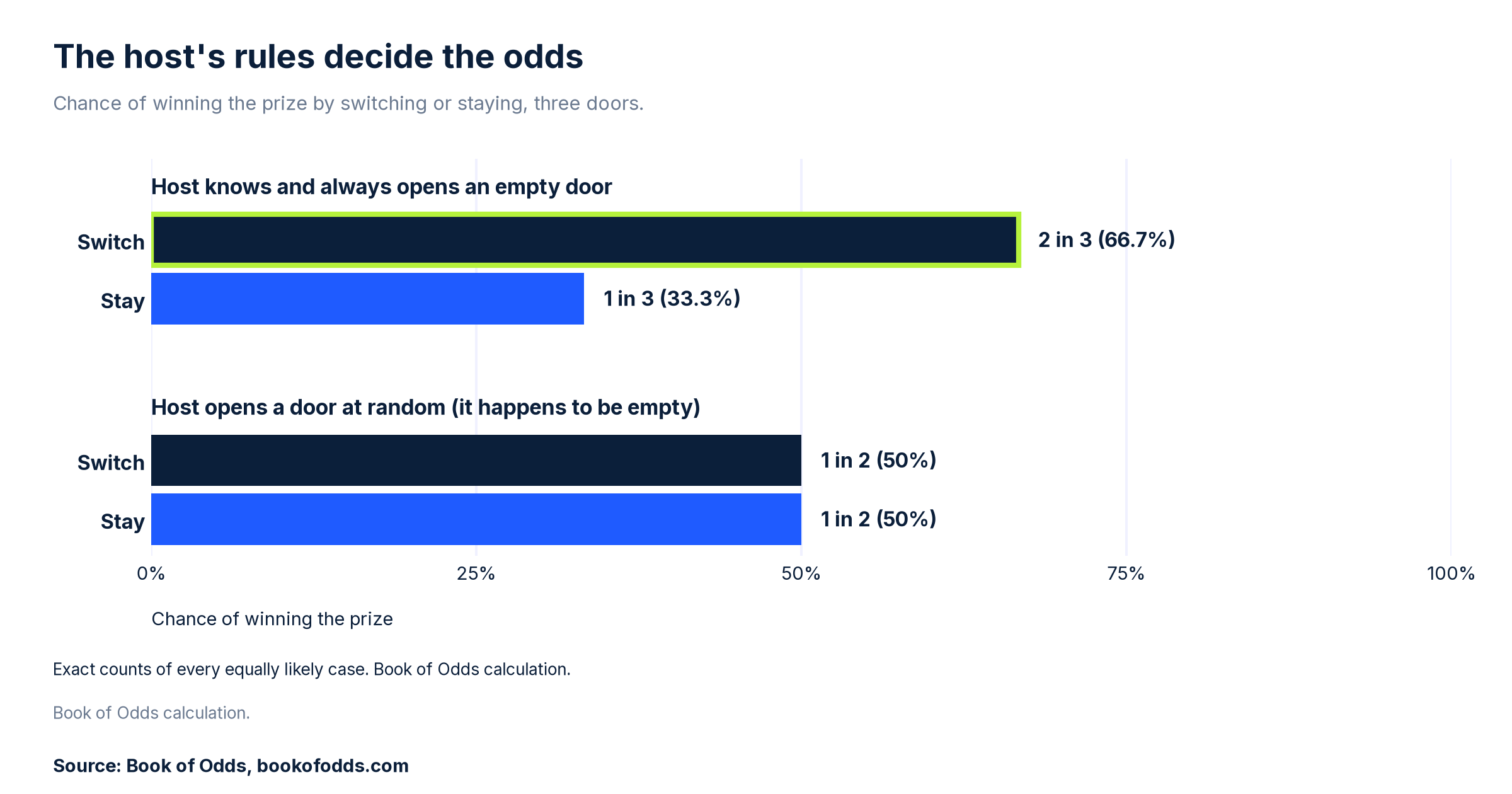
Switch: it wins 2 times in 3. That is the answer to the Monty Hall problem under its usual rules, and the rules are the whole story. One prize is placed at random behind one of three doors. The host knows where it is. After your pick, the host always opens a door you did not choose that hides nothing, picking one at random when both of those doors are empty, and always offers you the switch. Under exactly those rules, switching wins 2 times in 3 and staying wins 1 time in 3.
Why switching wins
Your first pick is right 1 time in 3. Nothing the host does afterwards changes that, because the host can always find an empty door to open, whatever you picked. So staying wins only in the games where your first pick was already right. Switching wins in all the others, because the host has cleared away the one empty door you did not pick and left the prize behind the door still closed.
Here are the three equally likely places the prize can be when your first pick is door 1, under the rules above.
| Prize is behind | Host opens | Staying gets | Switching gets |
|---|---|---|---|
| Door 1 | door 2 or door 3 | the prize | nothing |
| Door 2 | door 3 | nothing | the prize |
| Door 3 | door 2 | nothing | the prize |
Staying wins in one row out of three. Switching wins in two. In a simulation of 100,000 games under these rules, with a fixed random seed, switching won 66.48% of them, close to the exact 2 in 3 (our arithmetic).
The rule that changes everything
Now change one thing. Suppose the host does not know where the prize is and opens one of the two doors you did not pick at random. Sometimes the prize is revealed and the game is spoiled. Keep only the games where the door the host opens at random happens to be empty: in those games, switching and staying each win 1 time in 2. That empty reveal happens in 2 of every 3 such games.
The door you see opened is the same in both versions. What differs is why it was opened. A host who must avoid the prize is passing on information each time; a host who opens a door at random and happens to miss the prize is not.

A hundred doors
If the 2 in 3 still feels wrong, stretch the game. Under the same rules with 100 doors, you pick one, and the host, who knows where the prize is, opens 98 empty doors and leaves one other door closed. Your first pick was right 1 time in 100. Switching wins 99 times in 100. With three doors the same logic is simply harder to see.
Where the puzzle came from
The puzzle was in print by 1975. In an August 1975 letter to The American Statistician, “On the Monty Hall Problem,” the statistician Steve Selvin wrote, “Several correspondents claim my answer is incorrect.” He stated his assumption plainly: the host knows which box holds the prize, in his version a set of keys, and when he can open either of two empty boxes, he chooses between them at random. On that basis, he wrote, trading boxes wins 2 times in 3.
It later appeared in Marilyn vos Savant’s column in Parade magazine, where the material ran in 1990 and 1991. Her answer was to switch, with a 2 in 3 chance. The mail that followed, by her own account, ran to “thousands of letters, nearly all insisting that I’m wrong.” By her own count, 92% of the letters from the general public and 65% of those from universities were against her answer. Her later columns stressed the same condition this page starts with: the host “always opens a losing door on purpose.”
The short version
When the host knows where the prize is and always opens an empty door you did not pick, switching wins 2 times in 3 and staying wins 1 time in 3. When the host opens a door at random and it happens to be empty, each choice wins 1 time in 2. The host’s rules come first; the odds follow from them. For more puzzles like this, see our guide to probability, or test your gut on other puzzles in our quiz.
Last checked: 2026-10-19, against Steve Selvin’s August 1975 letter to The American Statistician and Marilyn vos Savant’s “Game Show Problem” page. This article was machine-checked against the sources above and has not been expert-reviewed. Spotted an error or a newer public figure? Please tell us on our contact page with the article link and we will review it.
Sources
- S1 Steve Selvin, “On the Monty Hall Problem,” in Letters to the Editor, The American Statistician, Vol. 29, No. 3 (August 1975), pp. 131 to 134, https://doi.org/10.1080/00031305.1975.10477398 , read from the transcription at https://www.montyhallproblem.com/as.html . Accessed Oct 19, 2026.
- S2 Marilyn vos Savant, “Game Show Problem” (material originally published in Parade magazine, 1990 and 1991), read from the Internet Archive copy of marilynvossavant.com, 2013. https://web.archive.org/web/2013/http://marilynvossavant.com/game-show-problem/ . Accessed Oct 19, 2026.
- Method: every win chance and the 100 door figure are Book of Odds arithmetic by exact enumeration in Python, under the rules stated beside them; the 100,000 game simulation (seed 20261019) is a Python cross-check under the same rules.