

Of every 1,000 individual tax returns filed for 2021, how many has the IRS audited: about 3, about 30 or about 100?
About 3. The IRS has examined 510,375 of the 161,206,833 individual returns filed for tax year 2021, roughly 1 in 316 (IRS Data Book 2025, Table 3-1).
That figure is the IRS’s own measure: returns filed for one tax year that it has examined, counting audits finished and audits still open as of Sep 30, 2025, divided by every individual return filed for that year. It is a rate per return, not per person. Why 2021 and not a newer year? The IRS calls tax year 2021 its most recent year outside the normal statute of limitations, generally three years, so its count is close to final. The rates for 2022 and 2023 will keep rising as more of their audits are opened and closed. The 2021 rate is no blip, either: the IRS prints 0.3% for 2019 and 2020 as well.
The odds by income: a U, not a ramp
Sort the 2021 returns by income and the audit rate traces a U. The IRS sorts by “total positive income”, which adds up the positive amounts on a return and leaves out losses.

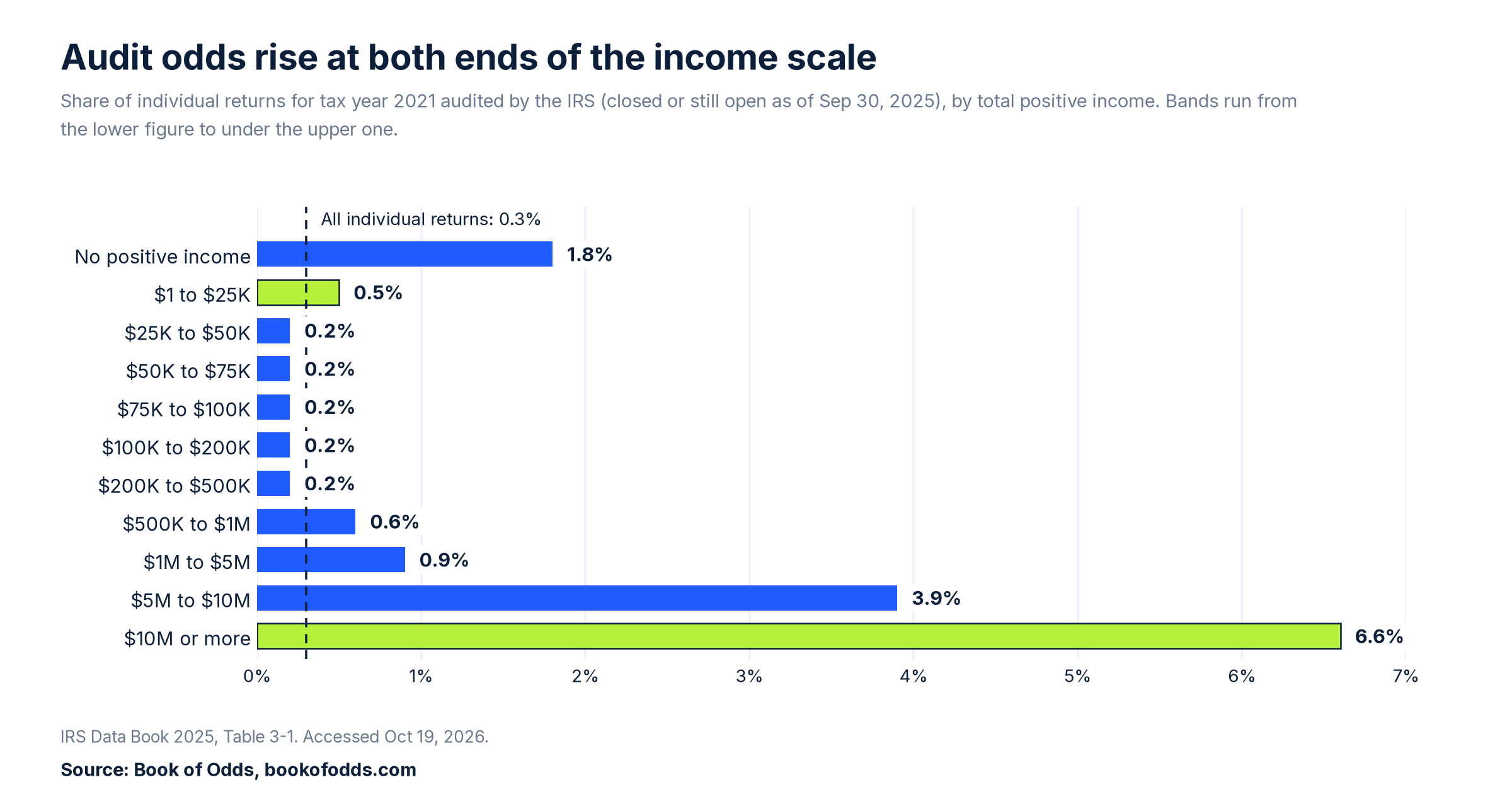
At the top, returns reporting $10,000,000 or more were audited at 6.6%, about 1 in 15. The bands just below run 3.9% for $5,000,000 to under $10,000,000 and 0.9% for $1,000,000 to under $5,000,000.
At the bottom, returns with $1 to under $25,000 were audited at 0.5%, about 1 in 198. That is more than twice the rate of any band from $25,000 to under $500,000, each printed at 0.2%. Returns reporting no positive income at all came in at 1.8%.
Beside those numbers sits one more line from the same table: 0.7% of returns claiming the earned income tax credit, about 1 in 144, were selected for audit on the basis of that claim. The IRS shows that line separately for information and counts the same returns inside the income bands above. The table does not say what drives the higher rate at the bottom.
What an audit usually looks like
Of the 441,578 individual audits the IRS closed in fiscal year 2025, 393,767 were handled by correspondence, about 9 in 10. Correspondence is the IRS’s term; in plain terms, it means audits done by mail (our inference). The odds favor the mailbox over the doorbell.
Not every audit changes anything. For tax year 2021, 65,979 of the 498,386 closed individual audits ended with no change, about 1 in 8.
The criminal side is a separate track
IRS Criminal Investigation (IRS-CI) describes itself as the law enforcement arm of the IRS and the only federal agency with authority to investigate potential criminal violations of the Internal Revenue Code. In fiscal year 2025, IRS-CI opened 2,792 criminal investigations. Only 968 of them, about a third, were what IRS-CI calls legal source tax crimes, a category that covers crimes involving legally earned income and also includes employment tax cases, questionable refund cases, unscrupulous return preparers and frivolous filers or nonfilers who challenge the filing requirements. The rest were illegal source financial crimes (1,246) and narcotics-related financial crimes (578).
The same year, IRS-CI referred 2,043 investigations for prosecution and recorded 1,611 convictions, and 75.9% of those sentenced were incarcerated, a term the IRS says can include home confinement. Those are separate yearly tallies, not stages of the 2,792: cases cross fiscal years, so each count describes a different set of cases. IRS-CI reports an 89% conviction rate, without defining it in the report.
Where do criminal cases start? In IRS-CI’s own chart of investigation sources for fiscal 2025, U.S. Attorney’s Offices account for 29%, other federal agencies 27% and IRS-CI itself 19%. The source labeled “IRS civil” accounts for 3%. The chart does not say what it counts or define “IRS civil”.
Among the sources here, the newest count of fraud referrals from the IRS’s civil side comes from the Treasury Inspector General for Tax Administration (TIGTA). In fiscal year 2023, IRS-CI received 157 fraud referrals from the IRS’s civil enforcement functions and accepted 68% of them. That same year, the IRS closed 582,944 audits of all kinds of returns. Even if every one of those referrals had come from an audit, that would be no more than about 1 referral for every 3,700 audits (our inference). Some referrals come from civil work other than audits, and a referral in one year can stem from an audit closed in another, so treat this as a rough ceiling, not a rate.
None of the sources here tracks what share of audits ends in a criminal case, a prosecution or a conviction.
Data limits
The audit rate is per return for a single tax year, counts audits both closed and still open as of Sep 30, 2025, and reads lower for newer tax years because their audits are unfinished. Income bands use total positive income, which leaves out losses, and returns claiming the earned income tax credit are also counted inside those bands. By IRS-CI’s own chart, most criminal investigations come from sources other than the IRS’s civil side, the chart does not say what it counts, and the newest civil fraud referral count found is for fiscal 2023. IRS-CI’s yearly counts of cases opened, referred and convicted describe different cases, because cases cross years.
The short version
For tax year 2021, the IRS has audited about 3 in 1,000 individual returns, roughly 1 in 316, with the odds rising at both ends of the income scale. The next IRS Data Book will print new counts, and this page will be rechecked against it.
Last checked: 2026-10-19, against the IRS Data Book 2025 (Tables 3-1, 3-2 and 3-10), the IRS Data Book 2023 (Table 18), the IRS Criminal Investigation Annual Report 2025 and TIGTA report 2025-3S0-028. This article was machine-checked against the sources above and has not been expert-reviewed. Spotted an error or a newer public figure? Please tell us on our contact page with the article link and we will review it.
Sources
- S1 IRS, Data Book, 2025 (Publication 55B, April 2026), Tables 3-1, 3-2 and 3-10, https://www.irs.gov/pub/irs-pdf/p55b.pdf ; tables at https://www.irs.gov/pub/irs-soi/25db-3-01-ex.xlsx , https://www.irs.gov/pub/irs-soi/25db-3-02-ex.xlsx and https://www.irs.gov/pub/irs-soi/25db-3-10-ci.xlsx ; highlights at https://www.irs.gov/statistics/compliance-presence . Accessed Oct 19, 2026.
- S2 IRS Criminal Investigation, Annual Report 2025 (Publication 3583, Rev. 3-2026), https://www.irs.gov/pub/irs-pdf/p3583.pdf , and press release of Dec 12, 2025, https://www.irs.gov/compliance/criminal-investigation/irs-ci-issues-fiscal-year-2025-annual-report-showcasing-banner-investigative-results . Accessed Oct 19, 2026.
- S3 Treasury Inspector General for Tax Administration, “Criminal Investigation Trends From Fiscal Year 2019 Through Fiscal Year 2023,” Report 2025-3S0-028, June 18, 2025, https://www.tigta.gov/sites/default/files/reports/2025-06/20253S0028fr.pdf . Accessed Oct 19, 2026.
- S4 IRS, Data Book, 2023 (Publication 55B), Table 18, IRS Data Book, 2023 (PDF). Accessed Oct 19, 2026.
- Method: odds (“1 in”), shares and per 1,000 figures are Book of Odds arithmetic from the IRS counts above. The “no more than about 1 referral for every 3,700 audits” reading of the fiscal 2023 referral ratio is our inference.