

Which of these killed the most people worldwide in 2024: malaria, measles or tuberculosis?
Tuberculosis, by a wide margin. WHO estimates TB killed 1.23 million people worldwide in 2024, against an estimated 610,000 for malaria and 95,000 for measles, and calls TB “the world’s leading cause of death from a single infectious agent.” Of the other infections on this page, hepatitis B came closest, at an estimated 1.1 million.
Ranking all of history is harder, because the estimates do not share a scale. One covers a single century in Europe, one covers about three years worldwide, one counts from the start of an epidemic that has not ended, one counts excess deaths from all causes, and smallpox has no reliable total in the sources we found. So this page has two lists: outbreaks on record, each on its own terms and not ranked, and a ranking of infections today on one basis only, WHO’s estimated deaths worldwide in 2024.
Outbreaks on record, in time order
These five are listed by date, not by size. Each estimate covers its own place and period, so the figures cannot be lined up against one another.
The Black Death, fourteenth century, Europe. WHO says plague, known as the Black Death during the fourteenth century, caused more than 50 million deaths in Europe. That is a WHO estimate for Europe alone, and WHO gives no range or method for it.
Smallpox, worldwide, until 1977. No reliable total for smallpox deaths exists in the sources we found. What the record does give is one year. In the 1988 WHO history of smallpox eradication, Fenner and colleagues estimate 10 million to 15 million cases and about 1.5 million to 2 million deaths worldwide in 1967 alone. Ten years later, on 26 October 1977, the last natural case occurred in Merca, Somalia.
The 1918 to 1920 influenza pandemic, worldwide. Johnson and Mueller (2002) estimate about 50 million deaths worldwide. Their abstract adds that even this figure “may be substantially lower than the real toll, perhaps as much as 100 percent understated,” which would put the toll at up to about 100 million (our arithmetic). That upper end is the authors’ caveat, not a second estimate. Earlier estimates, the same abstract notes, were about 21.5 million (a 1920s calculation) and 24.7 million to 39.3 million (a 1991 paper), and the estimate has been revised upward consistently since. An archived CDC page, which dates the pandemic 1918 to 1919, puts US deaths at about 675,000.
HIV and AIDS, worldwide, since the start of the epidemic. UNAIDS estimates that 44.2 million people died from AIDS-related illnesses from the start of the epidemic through 2025, within a range of 33.8 million to 61.1 million. For 2025 alone, UNAIDS estimates 570,000 deaths (range 430,000 to 780,000).
COVID-19, worldwide, 2020 to 2023. WHO estimates 22.1 million excess deaths from all causes worldwide from 2020 to 2023 (95% uncertainty interval 20.6 million to 23.6 million). Excess deaths are deaths above the expected level, direct and indirect, not only deaths recorded as COVID-19; reported COVID-19 deaths over the same years were 7.0 million.
Infections today, ranked on one basis
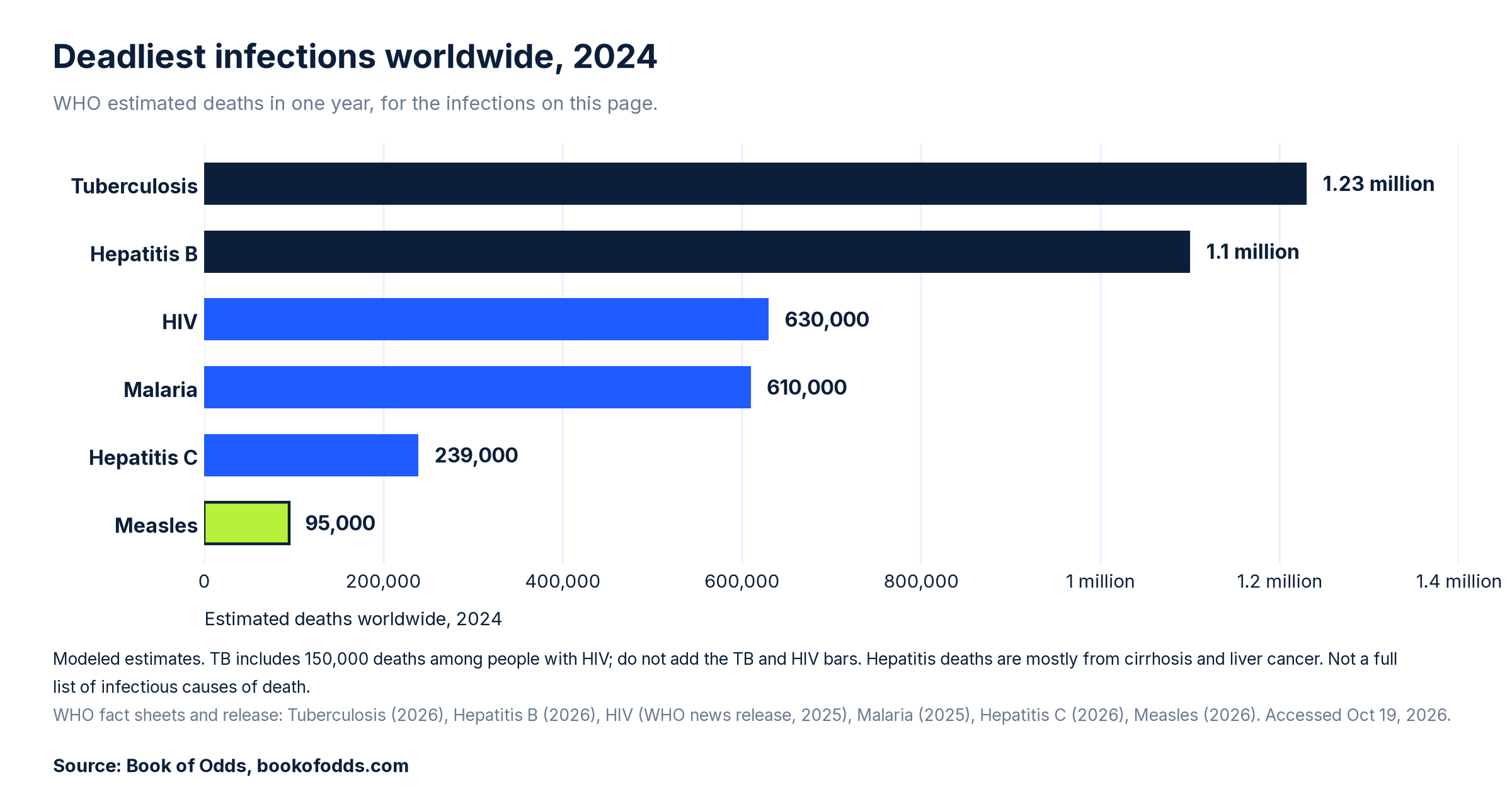
Among the infections on this page, WHO’s estimates for 2024 give this order. All six figures are WHO’s modeled estimates of deaths worldwide in that one year.
- Tuberculosis: an estimated 1.23 million deaths in 2024, including 150,000 among people with HIV. See also tuberculosis rates by US state.
- Hepatitis B: an estimated 1.1 million deaths in 2024, mostly from cirrhosis and liver cancer.
- HIV: an estimated 630,000 deaths from HIV-related causes in 2024. TB’s 150,000 deaths among people with HIV may also be counted here, so the two figures should not be added (our inference).
- Malaria: an estimated 610,000 deaths in 2024.
- Hepatitis C: an estimated 239,000 deaths in 2024, also mostly from cirrhosis and liver cancer.
- Measles: an estimated 95,000 deaths in 2024, mostly among unvaccinated or under vaccinated children under age 5.
This is not a full list of infectious causes of death. The HIV line in the history list is UNAIDS’s figure for 2025; the ranking uses WHO’s figure for 2024. The COVID-19 figure counts excess deaths from all causes over 2020 to 2023, so it stays out of the ranking.
WHO puts 95% of 2024 malaria deaths in its African Region, about 579,000, with children under 5 making up about three quarters of deaths there. For measles, WHO estimates about 2.6 million deaths a year before the vaccine arrived in 1963, and an estimated 780,000 in 2000.

Data limits
Historical tolls are estimates from incomplete records, each for its own place and period, so they are listed rather than ranked. We found no reliable all-time or 20th century total for smallpox, and Fenner and colleagues note that reported cases were only 1 to 2% of the true number. The 1918 figures come from the Johnson and Mueller abstract and an archived CDC page, and the upper end is the authors’ caveat. WHO’s 2024 figures are modeled estimates that WHO revises each year, and the ranking covers only the infections on this page. The COVID-19 figure is a modeled estimate of excess deaths from all causes, not of deaths recorded as COVID-19.
The short version
History’s tolls do not share a scale, so this page reads them one at a time. For today, one basis does exist: WHO estimates tuberculosis killed 1.23 million people worldwide in 2024, more than any other infection on this page.
Last checked: 2026-10-19, against WHO fact sheets, reports and releases on tuberculosis, hepatitis B and C, HIV, malaria, measles and plague, WHO’s World Health Statistics 2026, UNAIDS, an archived CDC page, the 1988 WHO history of smallpox eradication and Johnson and Mueller (2002). This article was machine-checked against the sources above and has not been expert-reviewed. Spotted an error or a newer public figure? Please tell us on our contact page with the article link and we will review it.
Sources
- S1 WHO, fact sheet “Tuberculosis,” 24 March 2026 (data year 2024), from the Global Tuberculosis Report 2025 (12 November 2025). https://www.who.int/news-room/fact-sheets/detail/tuberculosis . Accessed Oct 19, 2026.
- S2 WHO, fact sheet “Malaria,” 4 December 2025 (data year 2024), from the World Malaria Report 2025. https://www.who.int/news-room/fact-sheets/detail/malaria . Accessed Oct 19, 2026.
- S3 WHO, fact sheet “Measles,” 15 July 2026 (data year 2024). https://www.who.int/news-room/fact-sheets/detail/measles . Accessed Oct 19, 2026.
- S4 WHO, fact sheet “Plague,” 29 September 2026. https://www.who.int/news-room/fact-sheets/detail/plague . Accessed Oct 19, 2026.
- S5 Fenner F, Henderson DA, Arita I, Jezek Z, Ladnyi ID, “Smallpox and its Eradication,” WHO, Geneva, 1988. WHO record https://iris.who.int/handle/10665/39485 ; chapters read from the zero-pox.info copy. Accessed Oct 19, 2026.
- S6 Johnson NP, Mueller J, “Updating the accounts: global mortality of the 1918 to 1920 ‘Spanish’ influenza pandemic,” Bulletin of the History of Medicine 2002;76(1):105 to 115 (abstract). https://doi.org/10.1353/bhm.2002.0022 . Accessed Oct 19, 2026.
- S7 CDC, “1918 Pandemic (H1N1 virus),” archived page, last reviewed March 20, 2019. https://archive.cdc.gov/www_cdc_gov/flu/pandemic-resources/1918-pandemic-h1n1.html . Accessed Oct 19, 2026.
- S8 UNAIDS, “Global HIV and AIDS statistics, Fact sheet” (data year 2025). https://www.unaids.org/en/resources/fact-sheet . Accessed Oct 19, 2026.
- S9 WHO, fact sheet “Hepatitis B,” 28 July 2026 (data year 2024). https://www.who.int/news-room/fact-sheets/detail/hepatitis-b . Accessed Oct 19, 2026.
- S10 WHO, fact sheet “Hepatitis C,” 28 July 2026 (data year 2024). https://www.who.int/news-room/fact-sheets/detail/hepatitis-c . Accessed Oct 19, 2026.
- S11 WHO, “World Health Statistics 2026: monitoring health for the SDGs,” 13 May 2026, section 2.1.1, p. 34 (excess mortality, 2020 to 2023). https://iris.who.int/server/api/core/bitstreams/45189137-2f10-48e1-ae43-91b0d8ddd120/content . Accessed Oct 19, 2026.
- S12 WHO, news release “New prevention tools and investment in services essential in the fight against AIDS,” 1 December 2025 (data year 2024). https://www.who.int/news/item/01-12-2025-new-prevention-tools-and-investment-in-services-essential-in-the-fight-against-aids . Accessed Oct 19, 2026.
- Method: “up to about 100 million” is Book of Odds arithmetic from the Johnson and Mueller abstract’s caveat.