
Who posed for the golden knight handed out at the Oscars: a Mexican film extra, a famous leading man, or nobody at all?
Nobody, says the Academy: “No model was used during the design process” (Academy of Motion Picture Arts and Sciences).
This is a history page, not an odds page. Its numbers are the Academy’s own published specifications for the statuette, from its “Oscar Statuette” page, with NPR (2014) and BBC Culture (2016) for the model legend and the history of the metal.
The legend
A popular story says otherwise. In it, the actress Dolores del Río, who married the statuette’s designer Cedric Gibbons in 1930, suggested her friend Emilio Fernández, then a Hollywood extra in his mid 20s, as the model. Charles Ramirez Berg, a film professor, told NPR he first read it in a book by the Mexican film historian Emilio Garcia Riera: “The story is that Dolores Del Rio referred him to Emilio Fernandez and said you should use Emilio for the model”.
A librarian at the Academy’s library told NPR there is “zero proof any of that happened”. Laura Isabel Serna, a professor at the University of Southern California, told NPR there is “probably no hard evidence to back the story”. BBC Culture calls it “at best, apocryphal”. So this page tells it as a legend.
Serna told NPR it would be wonderful if it were true, because “it would be another bit of evidence of the involvement of Mexicans in particular, and Latinos more generally, in American cinema during its most formative years”.
What the statuette is
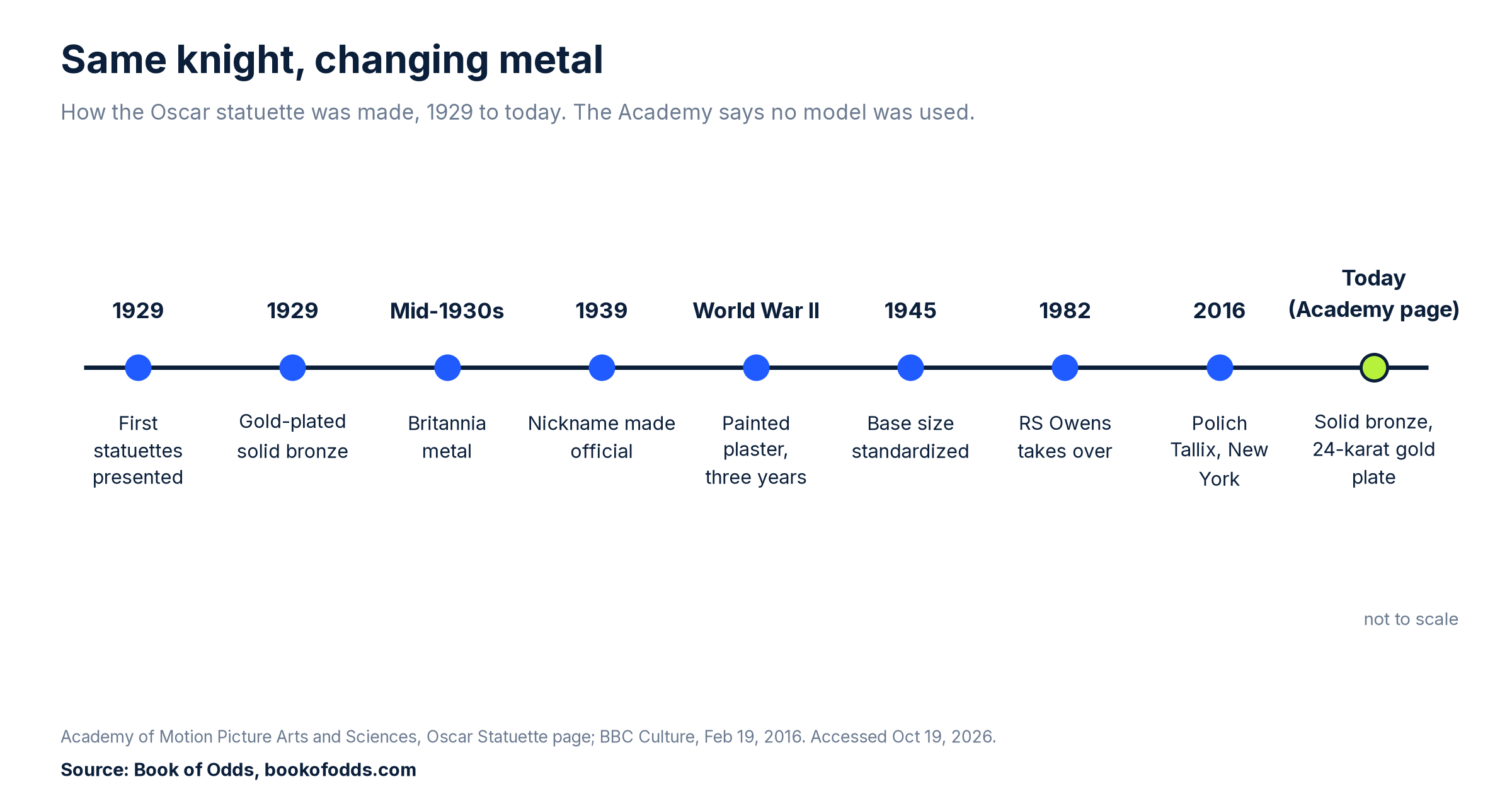
Gibbons, then MGM’s chief art director, designed a knight standing on a reel of film and gripping a crusader’s sword, and the Los Angeles sculptor George Stanley turned the drawing into three dimensions. The finished figure stands 13 1/2 inches tall and weighs 8 1/2 pounds. The reel has five spokes, one for each of the Academy’s five original branches: actors, directors, producers, technicians and writers. The size of the base varied until 1945, when the current standard was adopted.

What it is made of
The Academy’s page says the statuettes are solid bronze, plated in 24-karat gold. BBC Culture reports that the original Oscars were gold-plated solid bronze, but that by the mid 1930s bronze had given way to Britannia metal, a mix of tin, antimony and copper, under layers of copper, nickel silver and 24-karat gold. During World War II, a metal shortage meant the Oscars were painted plaster for three years, and after the war the Academy invited winners to trade them for metal ones.
Neither account says when today’s bronze took over from Britannia metal, so this page gives no year for it.
The makers have changed too. BBC Culture reported in 2016 that RS Owens and Company of Chicago had made the statuettes since 1982, and that from the 2016 Academy Awards the Polich Tallix company in New York would take over. The Academy says new statuettes are cast each January by Polich Tallix in New York’s Hudson Valley, and lists the manufacturing time as “3 months for 50 statuettes”.
The name
Officially, the statuette is the Academy Award of Merit. Where “Oscar” came from is not clear. In the Academy’s words, “a popular story” has the Academy librarian Margaret Herrick saying it looked like her Uncle Oscar. The name was well known enough by 1934 that the Hollywood columnist Sidney Skolsky used it, and the Academy adopted it officially in 1939. Five years (our arithmetic) is a reasonable trial period for a nickname. The first recipient was the actor Emil Jannings, and the first awards banquet was held on May 16, 1929, at the Hollywood Roosevelt Hotel.
The count this page cannot give
The Academy’s page does publish a total of statuettes presented, but the page’s text refers to the 2019 ceremony, so that total is out of date and this page does not print it. One more rule, from BBC Culture: since 1950, winners and their heirs may not sell an Oscar without first offering it to the Academy for $1.
Data limits
The size, weight, material and maker figures are the Academy’s published specifications, from a page whose text refers to the 2019 ceremony. The material history comes from one press account, BBC Culture in 2016, and the year bronze returned is not stated in the sources used here. None of those sources offers documentary evidence for the Fernández story, and the Academy says no model was used. A current count of statuettes presented is not given here.
The short version
No one posed for the Oscar, says the Academy: “No model was used during the design process”. The story of Emilio Fernández is a legend, and the statuette is a 13 1/2 inch, 8 1/2 pound knight that the Academy describes as solid bronze plated in 24-karat gold. When the Academy’s page changes, this page will be rechecked against it.
Last checked: 2026-10-19, against the Academy’s Oscar Statuette page, NPR (2014) and BBC Culture (2016). This article was machine-checked against the sources above and has not been expert-reviewed. Spotted an error or a newer public figure? Please tell us on our contact page with the article link and we will review it.
Sources
- S1 Academy of Motion Picture Arts and Sciences, “Oscar Statuette” page and facts box. https://www.oscars.org/oscars/statuette . Accessed Oct 19, 2026.
- S2 Shereen Marisol Meraji, “Latin Pride Swells For Mystery Model Behind Oscar Statuette”, NPR Code Switch, March 2, 2014. https://www.npr.org/sections/codeswitch/2014/02/28/284081430/latin-pride-swells-for-mystery-model-behind-oscar-statuette . Accessed Oct 19, 2026.
- S3 Jonathan Glancey, “Who was Oscar? A history of the Academy Awards statuette”, BBC Culture, Feb 19, 2016. https://www.bbc.com/culture/article/20160219-who-was-oscar-a-history-of-the-academy-awards-statuette . Accessed Oct 19, 2026.