

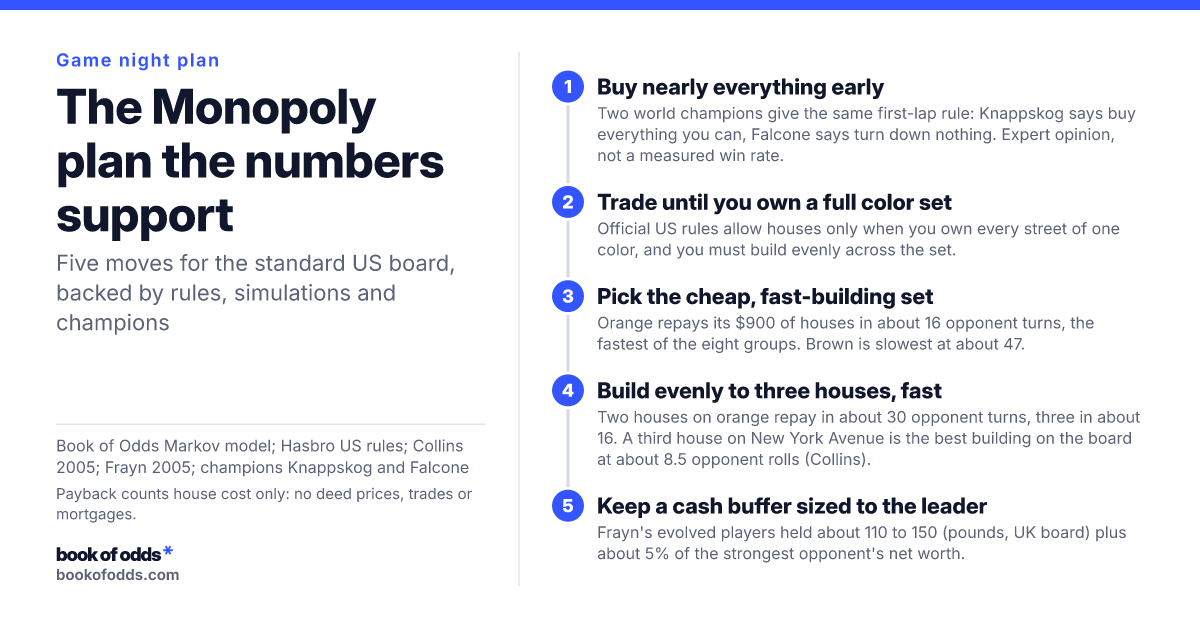
Win by buying nearly everything you land on early, trading until you own every street of one color, and putting three houses on that set before anyone else can. Keep enough cash to pay the rents you land on while you do it. Orange is the clearest example in our model: $900 of houses on St. James Place, Tennessee Avenue and New York Avenue earns about $55 of rent per opponent turn and pays for itself in about 16 opponent turns, the fastest of the eight color groups. Illinois Avenue is the busiest single property on the board, but one deed cannot hold a house, so the set matters more than the square.
The plan, in order
Two words first. A color set is every street of one color: all three oranges, both dark blues. Under the official US rules you cannot build a single house until you own the whole set, so the set, not the square, is the unit of this game. And every figure below is a long-run average: what happens per opponent turn across many turns, not what happens on the next roll. An opponent turn is one turn taken by one opponent.
- Buy nearly everything on the first lap. Two world champions give the same rule: Bjorn Halvard Knappskog, the 2009 champion, says buy everything you can, and Nicolo Falcone says turn down nothing. That is expert opinion rather than a measured win rate, but the simulations below reward the same habit.
- Trade until you hold a full color set. The rules allow houses only on a complete set, and the Wikibooks strategy guide argues that in a six-player game there is a fair chance nobody completes a group without trading. Trading is legal at any time, for unimproved property only.
- Prefer a cheap set you can develop quickly. In our model orange repays its houses in about 16 opponent turns. If orange is gone, dark blue (about 18), yellow (about 19) and red (about 20) repay next fastest, and light blue ($450 of houses) and pink ($900) repay in about 21 and about 23. Brown is the trap: $300 of houses, about $6 of rent per opponent turn, about 47 turns.
- Build evenly, and get to three houses fast. The rules force even building: no second house on a street until every street in the set has one. Two houses on every orange street repays in about 30 opponent turns; three houses repays in about 16. The third house alone repays in about 9 opponent turns.
- Hold a cash buffer sized to the leader, not the table. In Colin Frayn’s 2005 evolutionary study, the strategies that survived kept roughly 110 to 150 (pounds, UK board) plus about 5% of the strongest opponent’s net worth, and tracked the leader rather than the average player. Frayn says these numbers varied enormously between runs, so treat it as a habit, not a target.
- Leave Jail early, and argue about late. You get out by paying $50, playing a Get Out of Jail Free card, or trying for doubles for up to three turns. Early, when deeds are still unowned, everyone agrees you should pay and move. Late, the evidence splits, which the Jail section below sets out.
Which properties to target, and why

Payback here means one thing only: the cost of the houses divided by the expected rent per opponent turn, so it ignores the deed prices, trades and mortgages.
View the data table
| Outcome | |
|---|---|
| Orange ($900 of houses, about $55 rent per opponent turn) | 16 |
| Dark blue ($1,200, about $67) | 18 |
| Yellow ($1,350, about $71) | 19 |
| Red ($1,350, about $68) | 20 |
| Light blue ($450, about $21) | 21 |
| Green ($1,800, about $80) | 23 |
| Pink ($900, about $39) | 23 |
| Brown ($300, about $6) | 47 |
The orange case in full: houses cost $100 each, three houses bring rent to $550 on St. James Place, $550 on Tennessee Avenue and $600 on New York Avenue, and opponents land on orange about 9.7 times per 100 turns, roughly once every 10 turns. That is about $55 per opponent turn, so $900 of houses comes back in about 16 opponent turns. At a four-player table that is about 5 to 6 rounds of play.
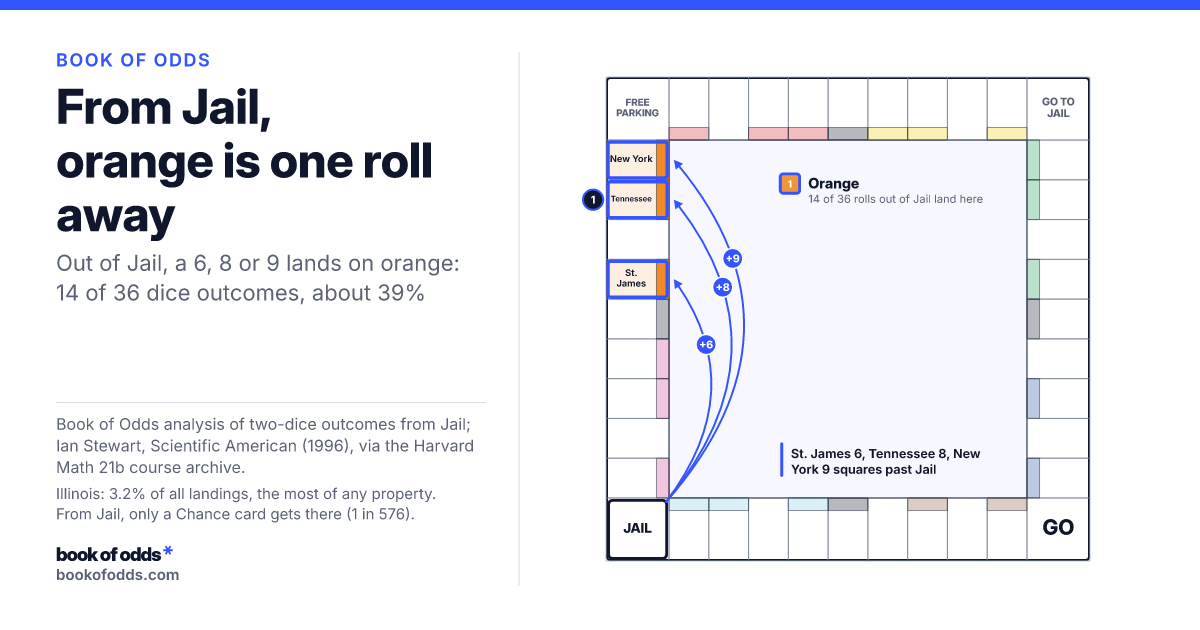
The traffic comes from Jail, which Ian Stewart’s 1996 Scientific American analysis puts at about 5.9% of long-run occupancy, almost twice any other square. St. James Place sits 6 squares past Jail, Tennessee 8 and New York 9. A single roll out of Jail lands on one of them 14 times in 36, about 39%, because 6 and 8 are among the commonest totals (5 ways each) and 9 is close behind (4 ways). Red is mostly out of range: Kentucky Avenue is 11 squares past Jail, reached by 2 of 36 rolls (about 5.6%), Indiana (13 squares) can’t be reached in one roll at all, and Illinois (14) only by a Chance card: roll a 12 onto Chance, then draw Advance to Illinois Avenue, about 1 time in 576 (0.17%).
Illinois Avenue is still the busiest single property, at about 3.2% of long-run occupancy in Stewart’s table, second only to Jail on the whole board. That is a share of time, not a per-roll chance, and a lone Illinois deed cannot hold a house until you also own Kentucky and Indiana. Busiest square and best investment are different questions.
Don’t chase the biggest rents
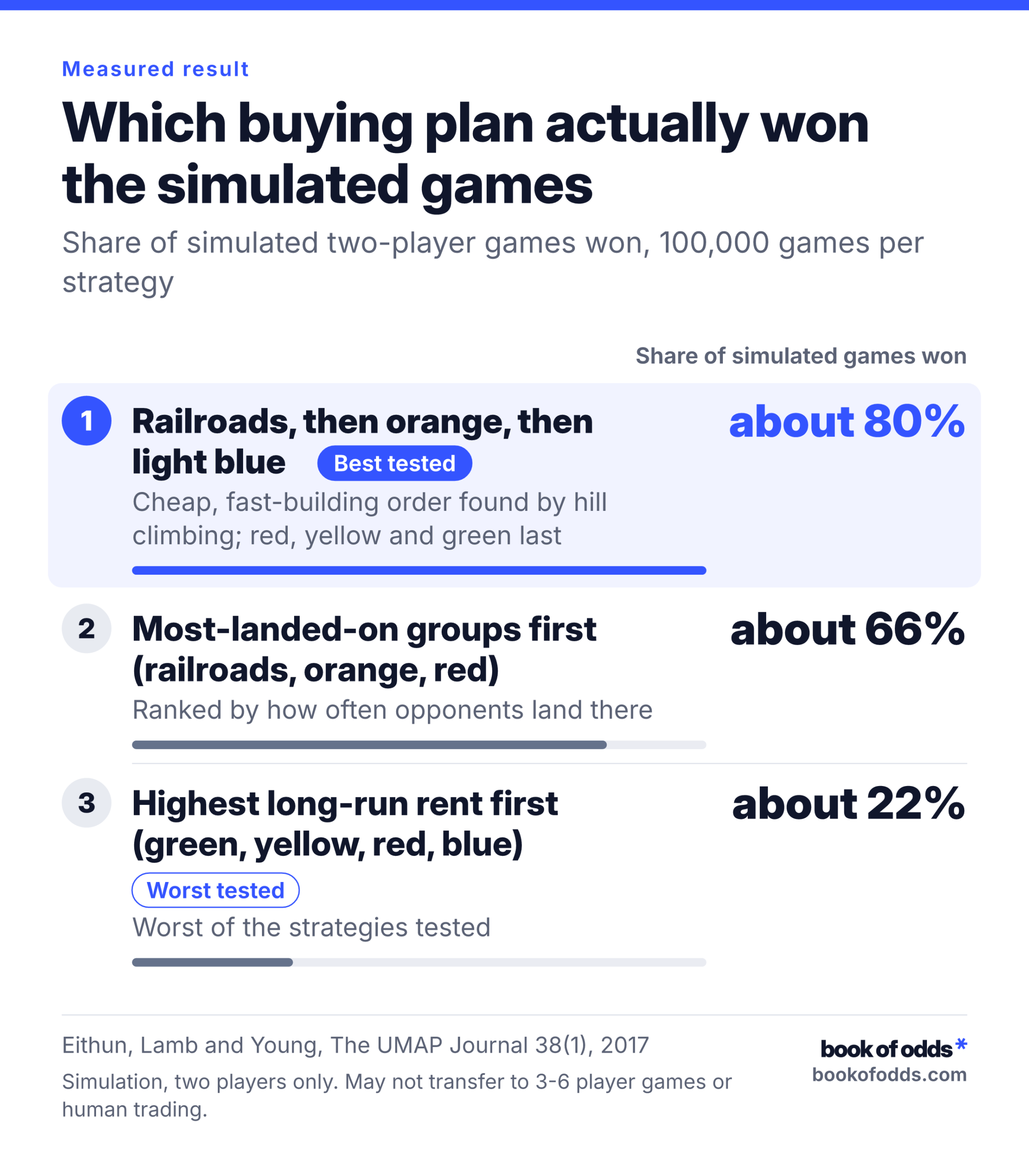
Measured result
Which buying plan actually won the simulated games
Share of simulated two-player games won, 100,000 games per strategy
Share of simulated games won
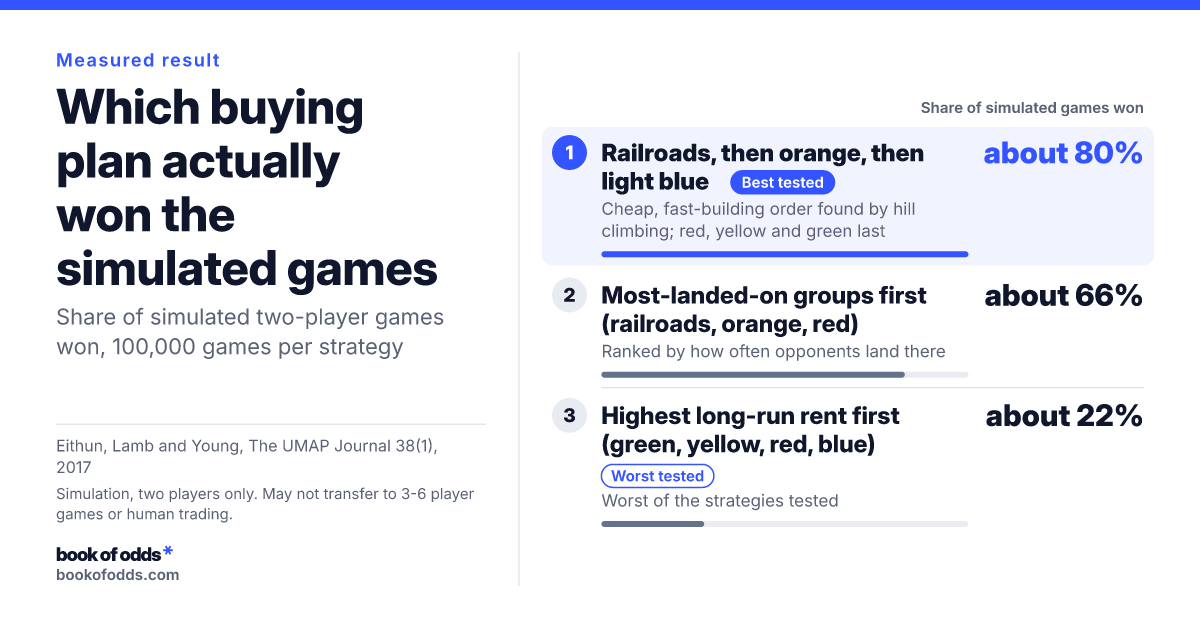
- Railroads, then orange, then light blue, highlighted Best tested Cheap, fast-building order found by hill climbing; red, yellow and green last about 80%
- Most-landed-on groups first (railroads, orange, red) Ranked by how often opponents land there about 66%
- Highest long-run rent first (green, yellow, red, blue) Worst tested Worst of the strategies tested about 22%
Eithun, Lamb and Young, The UMAP Journal 38(1), 2017
Simulation, two players only. May not transfer to 3-6 player games or human trading.
Green collects about $80 per opponent turn with three houses, yellow about $71, red about $68 and dark blue about $67, all more than orange’s $55. They also cost more to build, so they repay more slowly: green about 23 opponent turns, red about 20, yellow about 19, dark blue about 18.
The one head-to-head test we found agrees. In Eithun, Lamb and Young’s 2017 simulation of two-player games, a strategy that ranked color groups by long-run expected rent, greens and yellows first, won about 22% of games against randomly chosen fixed strategies, the worst result in the paper. Ranking by landing frequency won about 66%, and the best cheap-first order, railroads then orange then light blue, won about 80%. These are simulated games with restricted trades and two players, not people at a kitchen table.
A 2008 Stanford student model reaches the opposite conclusion, recommending yellow and green for games lasting more than about 30 throws. We do not follow it: it leaves out Chance and Community Chest, hands each player a color group at the start, and measures rent collected rather than games won.
How many houses, and when to stop
View the data table
| Outcome | |
|---|---|
| Two houses per street | 30 |
| Three houses per street | 16 |
| Four houses per street | 16 |
| A hotel on each street | 16 |
Truman Collins’s 2005 payback tables count the cost of each extra building against the extra rent it earns, measured in opponent rolls rather than turns, so read them alongside our group figures, not mixed into them. On almost every street the third house is the fastest-paying building on the board, and a third house on New York Avenue is the best of the lot at about 8.5 opponent rolls.
“Three houses, then stop” is a rule of thumb, not a law. On brown, each later building pays back faster than the third: Mediterranean Avenue’s third house takes about 39.1 opponent rolls, its fourth about 33.5, its hotel about 26.1. And for orange our own model has three houses at about 16 opponent turns, four houses at about 16 and a hotel at about 16, with the fourth house alone repaying in about 15 turns. Three houses is where the big gain arrives, not where value ends.
One reason to stay at houses is supply. A US set holds 32 houses and 12 hotels, and when the bank runs out nobody can build until houses are sold back. Upgrading to a hotel hands four houses back for someone else to use.
Railroads and utilities: the honest disagreement
Unresolved
Railroads: the one place the evidence and the champions split
What a published simulation measured, against what named champions advise, for the standard US board
What was measured
- Railroads ranked first in the winning order, ahead of orange and light blue.
- That order won about 80% of simulated games against randomly chosen fixed strategies.
- Two players only, with restricted one-for-one trades.
What the champions say
- Knappskog, 2009 world champion: never buy railroads or utilities.
- Falcone, world champion: own all four; four railroads charge $200 a landing.
- Collins, 2005: excellent when owned together, but outpaced by built streets later.
Split. One measured result favors railroads, two champions contradict each other, and we found no US-board payback figure.
Eithun, Lamb and Young, The UMAP Journal, 2017; Truman Collins, 2005; Knappskog via VICE, 2015; Falcone via Reader's Digest, 2025
No US-board payback figure for railroads is in hand, so no payback number is shown.
Book of Odds bookofodds.com
Download image of Railroads: the one place the evidence and the champions split
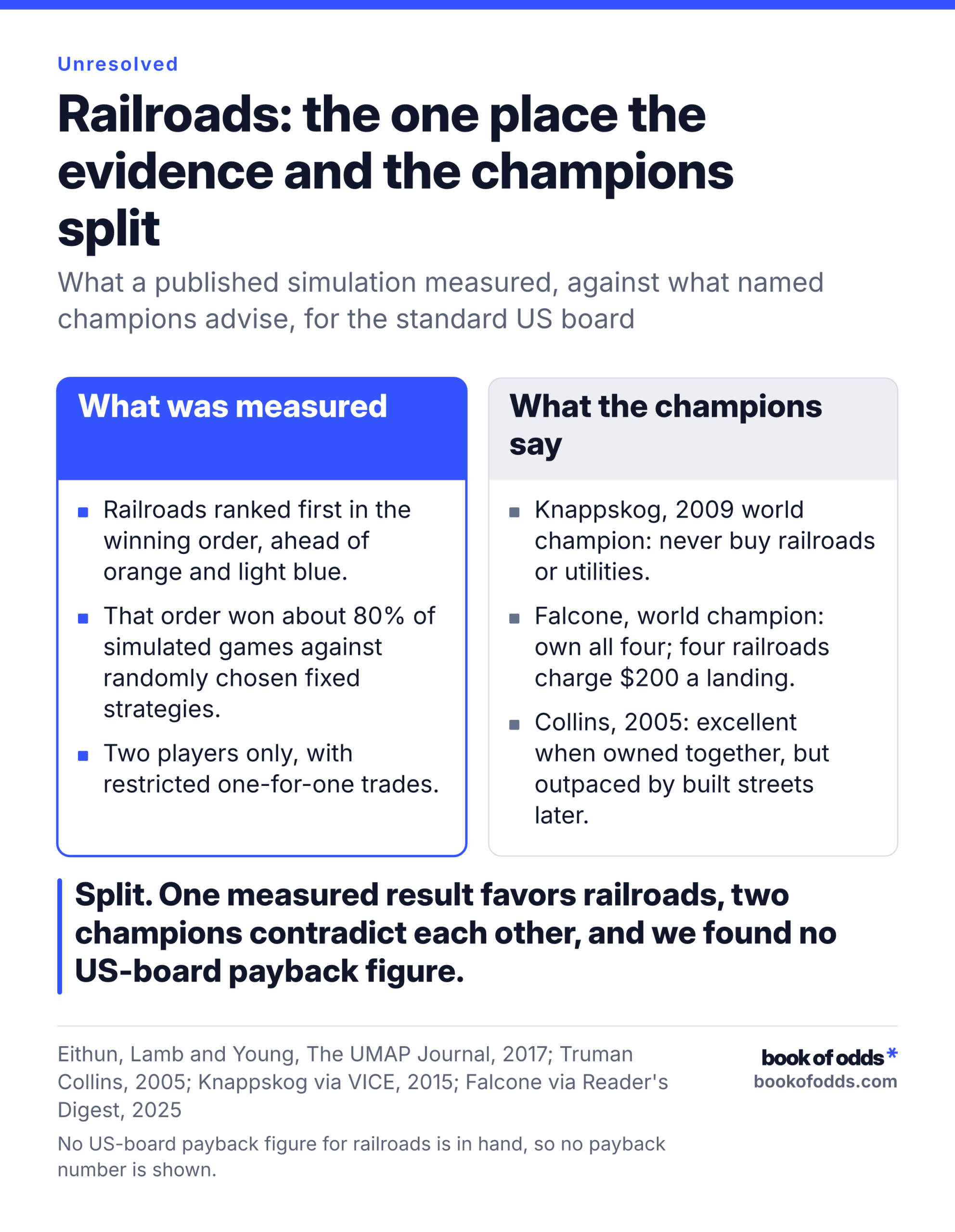
This is the clearest place where the measured result and champion opinion part ways, and we are not going to paper over it. The simulation that ranked railroads first tested two players with one-for-one property swaps; Falcone wants all four railroads, Knappskog would never buy one, and Collins thinks they are excellent early and outpaced once streets are built. No US-board payback figure for railroads is in hand, so we show none.
Utilities are simpler: no source we found supports paying full price for them.
Jail: an asset late, a liability early
Your Jail policy changes the board for everyone else. In our model, if opponents sit out their Jail term and try for doubles, opponents land on orange about 9.7 times per 100 turns; if they pay and leave at once, that rises to about 10.5, and orange’s payback shortens from about 16 opponent turns to about 15. Orange stays the fastest group either way.
The rules give you three ways out: pay $50 at the start of your next turn, use a Get Out of Jail Free card, or try for doubles for up to three turns, paying the $50 if you fail on the third. While you sit there you can still collect rent, build, bid in auctions and trade.
Late-game policy is unresolved. Collins advises leaving early and staying as long as possible later. Tim Darling says stay in once an opponent owns a monopoly. Frayn’s evolved players almost always paid to leave, and he notes that if you are hiding in Jail to dodge rent, you have probably lost anyway. No source measures the win-rate effect of a late-game Jail policy on its own.
Trading: how to get the set you need
Most monopolies are traded into existence, not landed on. The Wikibooks guide puts it plainly: in a six-player game there is a fair chance nobody completes a color group without a trade. That is reasoning, not a measurement, but the rules push the same way, since only a complete set can be built on.
Value a trade against payback, not against sticker price. A set you can take to three houses this lap beats a more expensive set you will be saving for: orange needs $900 of houses and repays in about 16 opponent turns, while green needs $1,800 and repays in about 23. A slightly unfavorable trade can still pay in a multi-player game, because every other player pays rent on the monopoly you create.
Two rules worth knowing before you haggle: you may trade property and Get Out of Jail Free cards at any time, but never improved property, and players may not lend each other money.
One piece of evidence about how to trade: in the 2017 two-player simulation, sticking to a fixed long-term priority order beat a strategy that traded for the best expected rent over the next few rolls in 70% of head-to-head games, and beat a novice-style strategy in 97%. Pick your target set, then trade toward it.
Early, middle and late game
Early: buy nearly everything, and take auctions seriously, because under the official rules any property you decline must be auctioned. A property you pass on is not a property nobody gets.
Middle: complete one cheap-side set, build it evenly to three houses, and keep the buffer that tracks the strongest opponent (about 110 to 150 plus 5% of their net worth in Frayn’s four-player games on the UK board).
Late: spend that income completing a second, more expensive set. Treat mortgaging as a last resort, since a mortgaged street collects no rent and lifting the mortgage costs the loan plus 10% interest under the 2007 US rules. Frayn’s evolved strategies reached the same conclusion about mortgages.
When someone else gets an early monopoly
Published advice converges on four moves. None of them has a measured effect on your chance of winning, and we could not resolve that in this pass, so treat them as tactics rather than findings.
- Refuse, or price up, any trade that completes the leader’s set.
- Make trades that give the other players monopolies, so the table can take the leader on together.
- Hold houses instead of upgrading to hotels. There are only 32 houses in the bank; as Knappskog puts it, owning 18 of them leaves 14 for everyone else.
- Court the near-bankrupt player. Whoever they sell to may decide the game.
What the odds cannot tell you
Player count, table talk, house rules and your own nerve sit outside every model here. So does the size of any single tactic’s effect: no source measures how much one move raises your chance of winning. The authors of the 2022 Purdue and USC reinforcement-learning study say plainly that no complete academic study of winning strategies exists. In their four-player games, the scripted player that chased railroads plus orange and light blue won about 14% of 10,000 games against 8.8% and 7.7% for the other scripted players in one line-up, but 6.9% against 8.7% and 7.5% in another, and a learning agent won most games in every line-up.
A 2023 hobbyist simulation of 1,000 six-player games is color, not proof: it reports that winners most often owned light blue, pink and orange (ownership above 35%, near 45% for light blue), which is what winners held, not how much holding them helps.
Note also that the studies differ in setup: two players in the 2017 simulation, four in Frayn’s and in the 2021-22 study, with UK streets in Frayn’s case. Take the shape of the advice, not the decimal places. And remember the observation of Philip Orbanes, chief judge at national and world Monopoly tournaments, that the players who do best are the easiest to get along with, because nobody minds losing to someone they like; there is more of that in our interview with Monopoly historian Phil Orbanes. If you came for where the board itself came from rather than how to beat it, read Monopoly’s secret history.
How we calculated this
Landing rates are modeled, not observed. We solved a turn-by-turn Markov chain of the standard US board: two fair dice, doubles roll again, three doubles sends you to Jail, the Go To Jail square, 16 Chance cards (10 of which move the token) and 16 Community Chest cards (2 of which move it), with the decks reshuffled before every draw. Every landing counts, including one made on a doubles re-roll, because rent is owed each time. Our figures reproduce Bill Butler’s published table of mean visits per turn, column “Intend three turns in Jail”: orange 9.69% of turns, red 9.53%.
Rent per opponent turn is the sum, across a group’s streets, of visits per turn times the rent with three houses. For orange that is $54.93, and $900 of houses divided by $54.93 is 16.4 opponent turns, which we print as about 16. Payback counts house cost only. Add the deed prices and orange takes about 27 turns, still the fastest group. Butler’s end-of-turn occupancy table is a different measure and would give about 19 turns for orange, which is why we never mix the two.
Stewart’s 3.18% for Illinois Avenue and 5.89% for Jail are long-run occupancy shares, printed here as about 3.2% and about 5.9%; they are not per-roll landing chances. Rents and house costs are the US title deeds; rules are Hasbro’s US rules. Simulation results are named with their conditions. Probabilities of 10% or more are rounded to a whole percent, smaller ones to one decimal, and paybacks to whole turns.