
In 2024, about how many people in the US went to a hospital emergency room with an injury involving adhesive tape: about 280, about 2,800 or about 28,000?
About 2,800, by our estimate. We built it from the Consumer Product Safety Commission’s National Electronic Injury Surveillance System (NEISS), which records injuries treated in a national probability sample of US hospital emergency departments. CPSC turns that sample into national figures by giving each case a statistical weight and adding the weights up. We applied that method to CPSC’s 2024 case file: 57 sampled tape cases, weighted to about 2,800 ER visits. CPSC did not publish this figure; it is our arithmetic on CPSC’s data.
What counts as tape
NEISS has its own product code for tape, 0927, “Tapes (with adhesive surfaces)”. The January 2024 NEISS coding manual assigns masking tape and electrician’s tape to that code and says first aid or medical tapes should not be reported. Some 2024 case notes still describe reactions to medical adhesive tape, and those cases are in the count. A case can list up to three products, so one injury can count toward tape and toward another product, such as a ladder, at the same time.
Tape against two other household things
Leaf blowers and hair dryers have their own NEISS codes too, so we measured them the same way, from the same 2024 file. We have also looked at ER visits involving beds, mattresses and pillows, using older NEISS data.
- Hair dryers: about 1,400 ER visits in 2024 (37 sampled cases).
- Adhesive tape: about 2,800 in 2024 (57 sampled cases).
- Leaf blowers: about 6,300 in 2024 (121 sampled cases).

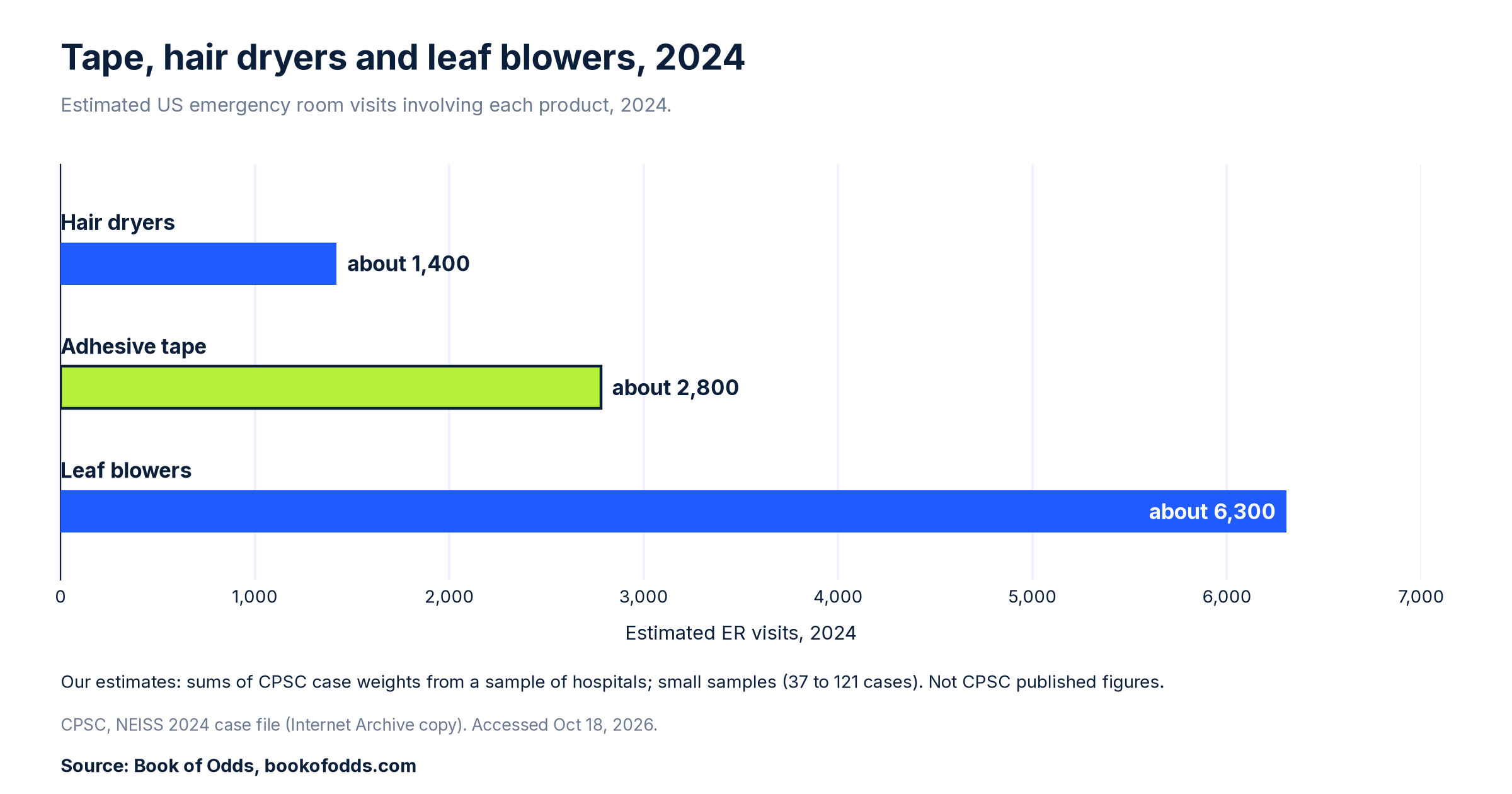
By our arithmetic, leaf blowers were involved in about 2.3 times as many US ER visits as tape in 2024, and tape in about twice as many as hair dryers. All three are estimates from small samples, so the gaps are rough.
What the case notes say
Several of the 2024 case notes describe cuts from the knife, razor blade or scissors being used to cut the tape. Others are stranger. Each note is a short summary written from the ER record, quoted here exactly as CPSC published it.
“2YOF STUCK A PIECE OF BLUE TAPE IN HER L NOSTRIL TODAY AT HOME. DX: F.B. IN NOSE”
NEISS case 240919787, 2024
“59YOF STS DUCT TAPE FELL OFF LADDER AND HIT PT IN BRIDGE OF NOSE DX ACUTE NASAL BRIDGE TRAUMA AND ECCHYMOSIS”
NEISS case 240363346, 2024
“24YOF WAS CUTTING TAPE BY PUTTING IT IN HER MOUTH AND SHE LAUGHED AND SWALLOWED A PIECE DX: FOREIGN BODY INGESTION OF PACKING TAPE”
NEISS case 240926170, 2024
By NEISS convention, each note starts with age and sex (“2YOF” is a 2 year old female, “59YOF” a 59 year old female), and “DX” marks the diagnosis.
Data limits
Every figure here is a 2024 estimate from one sample of US hospital emergency departments. CPSC’s 2024 estimates come from a sample of 100 hospitals, 77 of which reported that year. NEISS counts people treated in an ER, not people hurt at home who never went, and it counts products involved, which is not proof that the product caused the injury. The national figures are our sums of CPSC’s case weights, using the method CPSC describes, not numbers CPSC printed for these codes. We found no NEISS file newer than 2024 that we could open.
The short version
By our estimate from CPSC’s 2024 injury sample, adhesive tape was involved in about 2,800 US emergency room visits that year: more than hair dryers, fewer than leaf blowers.
Last checked: 2026-10-20, against CPSC’s 2024 NEISS case file, its 2024 NEISS Data Highlights and the January 2024 NEISS Coding Manual. This article was machine-checked against the sources above and has not been expert-reviewed. Spotted an error or a newer public figure? Please tell us on our contact page with the article link and we will review it.
Sources
- S1 US Consumer Product Safety Commission, NEISS 2024 case file (neiss2024.tsv, with Weight, Stratum and PSU columns), read from the Internet Archive copy of Aug 6, 2026. https://www.cpsc.gov/cgi-bin/NEISSQuery/Data/Archived%20Data/2024/neiss2024.tsv . Accessed Oct 18, 2026.
- S2 US Consumer Product Safety Commission, “NEISS Data Highlights (Top 20 Product Groups by Age Group), 2024,” footnotes on estimates and CV. Accessed Oct 18, 2026.
- S3 US Consumer Product Safety Commission, NEISS Coding Manual, January 2024, product codes 0927, 1461 and 1602, read from an Internet Archive copy. Accessed Oct 18, 2026.
- Method: every national estimate, “about 2.3 times” and “about twice” are Book of Odds arithmetic from CPSC’s 2024 case weights, not CPSC published figures; “several” cuts is our reading of the case notes.