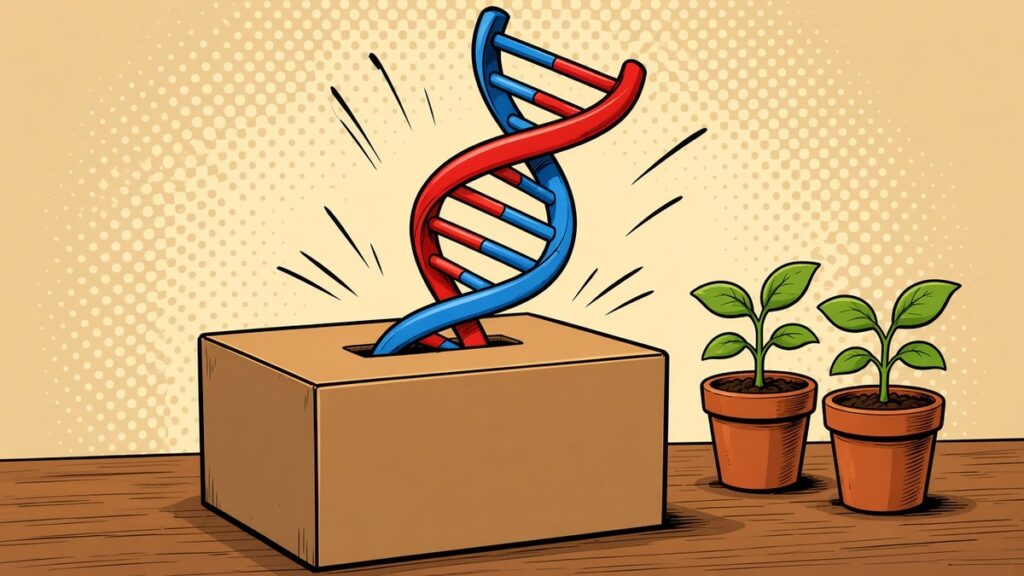

Do your genes have anything to do with your political views, is there a single gene that makes a person lean one way or the other, and does the way your body reacts to a sudden loud noise go with where you stand on the issues? Taking the three questions in turn, studies from 2008, 2014 and 2020 give a qualified yes, not so far, and a finding that did not hold up when another team repeated it.
What the twin studies found
A 2014 analysis of over 12,000 twin pairs from nine studies in five democracies found that genetic factors play a role in forming political ideology. The pairs were sampled over four decades. The authors, Hatemi and 14 coauthors writing in the journal Behavior Genetics, say this held “regardless of how ideology is measured, the era, or the population sampled.” The one exception they report is a question that explicitly uses the phrase “Left-Right”.
The idea is not new. According to the same 2014 paper, large studies of adult twins and their relatives almost 40 years earlier had suggested “that between 30 and 60% of the variance in social and political attitudes could be explained by genetic influences.” That range is the 2014 authors’ summary of the earlier studies, not a result of the 2014 analysis.
In plain terms, these figures are about differences between people in a sample. They do not say how much of any one person’s views comes from genes.
No single gene
The same 2014 paper also searched the whole genome for specific genetic markers linked to political ideology, using three samples: a 1990 Australian sample of 6,894 people from 3,516 families, a 2008 Australian sample of 1,160 related people from 635 families, and a 2010 Swedish sample of 3,334 people from 2,607 families. With the three samples combined, no marker reached the strict statistical threshold used for genome scans. In the paper’s words, “No polymorphisms reached genome-wide significance in the meta-analysis.”
The authors’ reading is that genetic influences on complex traits like ideology “will be composed of thousands of markers of very small effects” and that finding specific ones will take extremely large samples.
The threat reflex study
In 2008, a team led from the University of Nebraska-Lincoln reported in the journal Science on 46 adult participants with strong political beliefs. People with measurably lower physical reactions to sudden noises and threatening images were more likely to support foreign aid, liberal immigration policies, pacifism and gun control. People with measurably higher reactions to the same stimuli were more likely to favor defense spending, capital punishment, patriotism and the Iraq War. The authors describe these as correlations between physiological traits and political attitudes.
The 2008 abstract does not say these reflexes are inherited. Hatemi is a coauthor of both the 2008 and the 2014 papers, so the two are not independent confirmation of each other.
The 2020 replication
In 2020, four researchers from the University of Amsterdam, Rutgers University and Temple University reported in Nature Human Behaviour that independent laboratories had not replicated the original threat study. They ran a preregistered direct replication with 202 participants, plus conceptual replications in the United States with 352 participants and in the Netherlands with 81.
“Our analyses do not support the conclusions of the original study,” the authors wrote. They also found no evidence for broader claims about disgust or about a physiological trait. Identical twins share their genes; studies, it turns out, do not always share their results.
The short version
Twin studies, including a 2014 analysis of over 12,000 pairs, find that genetic differences go with differences in political ideology across people. A genome search in the same paper found no single gene behind it. And the 2008 finding that reactions to threats went with political views did not hold up when a different team repeated it in 2020.
Last checked: 2026-10-20, against the PubMed abstracts of Hatemi and colleagues (Behavior Genetics, 2014), Oxley and colleagues (Science, 2008) and Bakker and colleagues (Nature Human Behaviour, 2020). This article was machine-checked against the sources above and has not been expert-reviewed. Spotted an error or a newer public figure? Please tell us on our contact page with the article link and we will review it.
Sources
- S1 Hatemi PK, Medland SE, Klemmensen R, et al. “Genetic influences on political ideologies: twin analyses of 19 measures of political ideologies from five democracies and genome-wide findings from three populations.” Behavior Genetics, May 2014, 44(3):282 to 294. https://doi.org/10.1007/s10519-014-9648-8 . PubMed abstract (PMID 24569950), saved copy accessed Oct 20, 2026.
- S2 Oxley DR, Smith KB, Alford JR, Hibbing MV, Miller JL, Scalora M, Hatemi PK, Hibbing JR. “Political attitudes vary with physiological traits.” Science, September 19, 2008, 321(5896):1667 to 1670. https://doi.org/10.1126/science.1157627 . PubMed abstract (PMID 18801995), saved copy accessed Oct 20, 2026.
- S3 Bakker BN, Schumacher G, Gothreau C, Arceneaux K. “Conservatives and liberals have similar physiological responses to threats.” Nature Human Behaviour, June 2020, 4(6):613 to 621. https://doi.org/10.1038/s41562-020-0823-z . PubMed abstract (PMID 32042109), saved copy accessed Oct 20, 2026.