

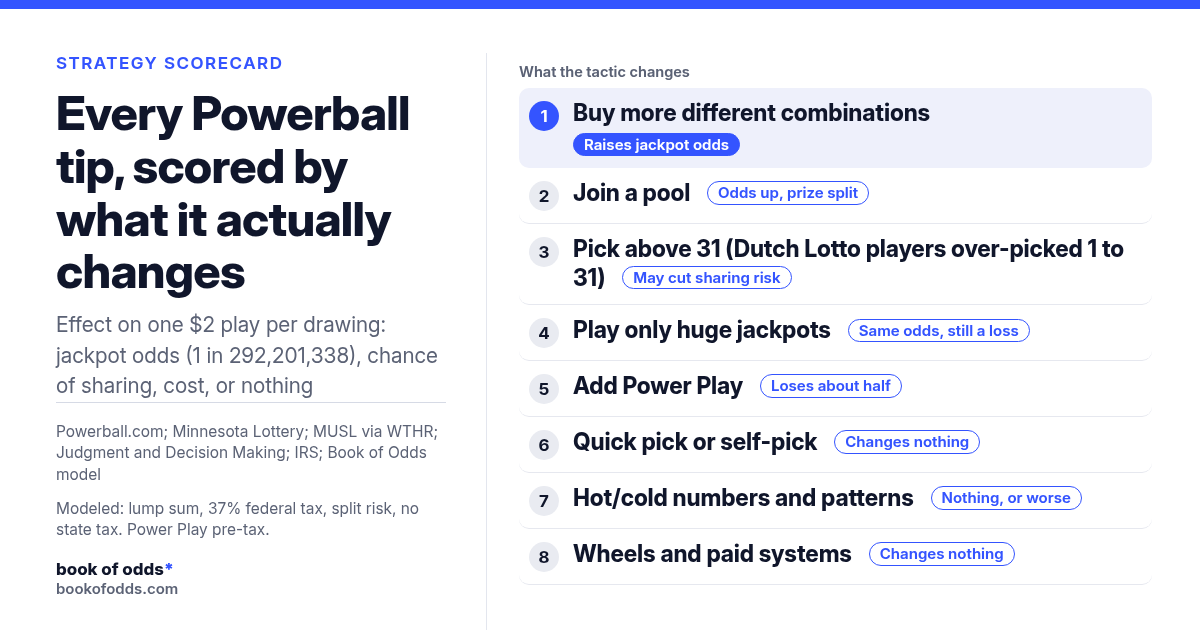
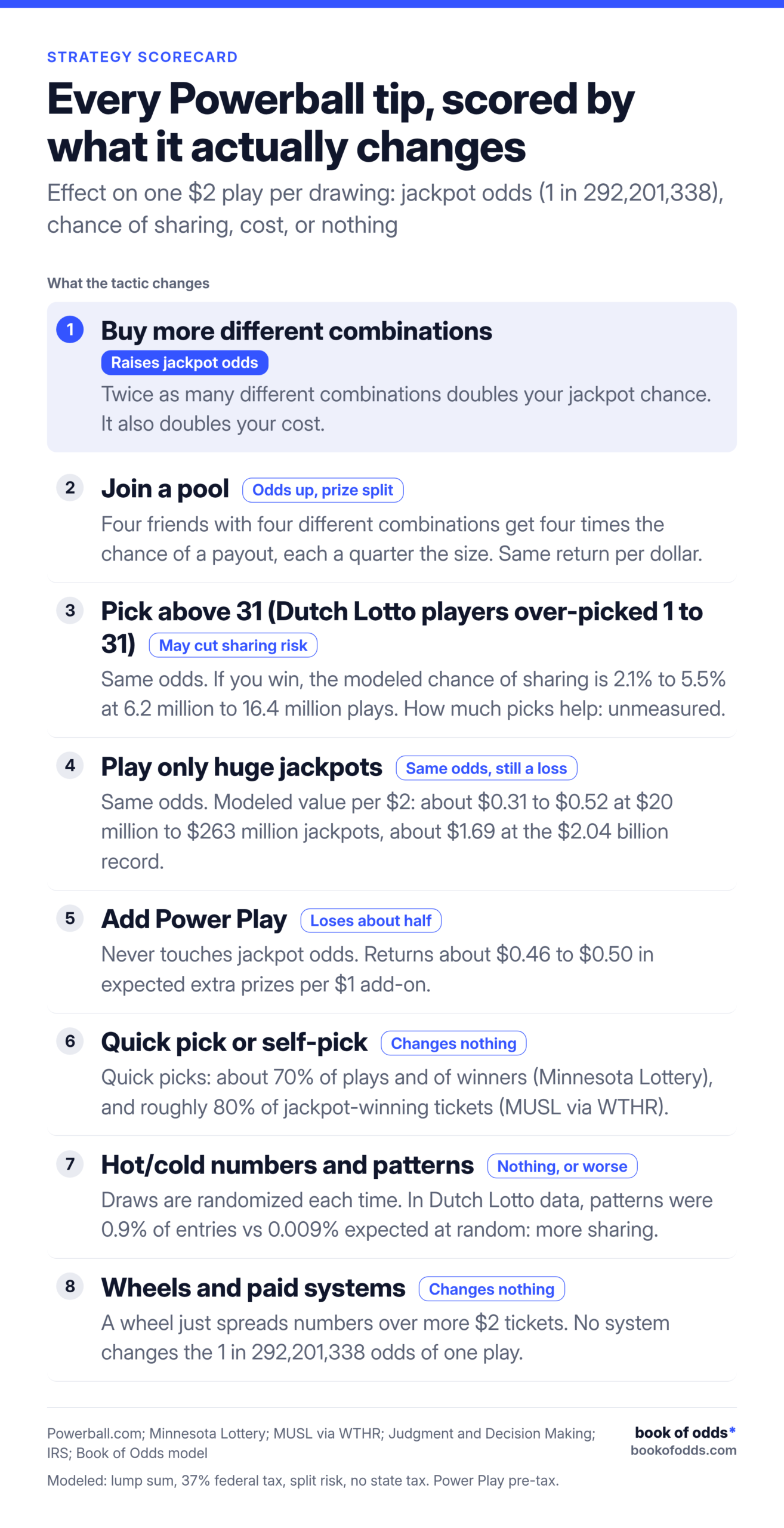
No Powerball strategy changes the odds of a single $2 play. It is 1 in 292,201,338 per drawing whether you use quick pick, birthdays or a paid system. Buy twice as many different number combinations and you double your chance of winning the jackpot. You also double your cost. Different choices change different things. Numbers above 31 may lower the chance of sharing a jackpot, but they do not change the odds. Power Play’s expected extra prizes in our model are about half its $1 price. A ticket’s cost is spent whether or not it wins.
Where the odds come from
View the data table
| Outcome | |
|---|---|
| Jackpot: 5 white balls + Powerball | 292,201,338 |
| Match 5: $1,000,000 | 11,688,053.5200 |
| Match 4 + Powerball: $50,000 | 913,129.1800 |
| Match 4: $100 | 36,525.1700 |
| Match 3 + Powerball: $100 | 14,494.1100 |
| Match 3: $7 | 579.7600 |
| Match 2 + Powerball: $7 | 701.3300 |
| Match 1 + Powerball: $4 | 91.9800 |
| Powerball only: $4 | 38.3200 |
| Any prize | 24.8700 |
Powerball.com lays out the game. You choose five white balls from 1 to 69 and one red Powerball from 1 to 26, and each play costs $2 (in Idaho and Montana, Powerball is bundled with Power Play at a $3 minimum). The order of the white balls does not matter.
Now count the tickets that could exist. There are 11,238,513 ways to choose five white balls from 69. Multiply by 26 possible Powerballs and you get 292,201,338 combinations. Your play holds one of them, so your chance of the jackpot in one drawing is 1 in 292,201,338, or about 1 in 292.2 million.
Drawings happen three times a week, Monday, Wednesday and Saturday at 10:59 pm ET, at the Florida Lottery draw studio in Tallahassee. The Monday drawing began August 23, 2021. In the United States, tickets are sold in 45 states, the District of Columbia, Puerto Rico and the U.S. Virgin Islands.
The jackpot is one of nine prize tiers. Your chance of winning any prize at all is 1 in 24.87 per play, and most of those wins are $4 prizes: the Powerball alone (1 in 38.32) or one white ball plus the Powerball (1 in 91.98). Lower-tier prizes are fixed cash amounts everywhere except California.
The game got harder in October 2015, when Powerball moved from 5 of 59 white balls plus 1 of 35 red to today’s 5 of 69 plus 1 of 26, according to the North Carolina Education Lottery. Overall prize odds improved from 1 in 32 to 1 in 25, but jackpot odds lengthened from about 1 in 175 million to about 1 in 292 million. Older figures you may see, such as 1 in 195,249,054, describe an older 5/59 + 1/39 version of the game. For the same kind of arithmetic on other games, see our page on the odds of winning a jackpot.
Every popular strategy, scored
The scorecard at the top of this page sorts every common tip by what it actually changes: your jackpot odds, your chance of sharing, your cost, or nothing. Here are the full verdicts for the tips that end here.
Quick pick versus your own numbers. A quick pick is a ticket the terminal fills with random numbers. The Minnesota Lottery’s Lotto Games FAQ says about 70 percent of plays are quick picks and about 70 percent of winners hold them. The Multi-State Lottery Association, quoted by WTHR in 2022, put quick picks at roughly 80% of jackpot-winning tickets. The shares are in the same range, which is what equal odds would predict, but they come from different sources and are not a test. The math is the reason neither method wins more often.
Hot and cold numbers. A hot number has come up often lately; a cold one hasn’t. Powerball uses physical machines and ball sets chosen at random from a sealed vault before each drawing. Balls are weighed, machines are tested, and the drawing is recorded under the observation of an independent accounting firm. The machine has no memory of last Saturday. One honest limit: this verdict rests on how the draw is run. We have not run a statistical test on past results.
Odd/even balance and patterns. Every combination is equally likely, so a balanced mix of odd and even numbers has the same 1 in 292,201,338 chance as any other ticket. In Dutch Lotto data, patterns are worse than neutral for sharing; we assume Powerball players behave similarly. In peer-reviewed research on millions of lottery entries, diagonal and vertical patterns on the play slip showed up in 0.9% of combinations, against 0.009% expected at random. If a pattern ever hits, the Dutch data suggest you are more likely than other winners to have company.
Wheels and paid systems. A wheel is a scheme for spreading a set of favorite numbers across many tickets. It buys more combinations at $2 each and does nothing else. Software and systems sold online either work the same way or do nothing at all, because no method changes the odds of a single play.
Five tips get their own sections below because they change something real: buying more tickets and joining a pool (your odds and your cost), picking unpopular numbers (your chance of sharing), playing only big jackpots (your expected value) and Power Play (your cost).
More tickets and pools: how fast the odds grow
View the data table
| Outcome | |
|---|---|
| 1 ticket per drawing, 10 years | 0.00053 |
| 1 ticket per drawing, 30 years | 0.0016 |
| 1 ticket per drawing, 50 years | 0.0027 |
| 5 tickets per drawing, 10 years | 0.0027 |
| 5 tickets per drawing, 30 years | 0.008 |
| 5 tickets per drawing, 50 years | 0.0130 |
| 20 tickets per drawing, 10 years | 0.0110 |
| 20 tickets per drawing, 30 years | 0.0320 |
| 20 tickets per drawing, 50 years | 0.0530 |
Buy twice as many different number combinations and you double your chance of winning the jackpot. You also double your cost. One combination gives you a 1 in 292,201,338 chance per drawing. Two different combinations give you two chances: your probability doubles, and so does your spending. The combinations must differ, since a second copy of the same numbers adds no chance. Twenty different combinations in one drawing get you to about 1 in 14.6 million, at 20 times the price.
Now stretch that over decades. Say you buy tickets for every drawing, all 156 a year. Your chance, as one player, of at least one jackpot works out to:
- 1 ticket per drawing: about 0.00053% after 10 years, 0.0016% after 30 and 0.0027% after 50.
- 5 tickets per drawing: about 0.0027%, 0.008% and 0.013%.
- 20 tickets per drawing: about 0.011%, 0.032% and 0.053%.
So 20 tickets every drawing for 50 years gives you about a 0.053% chance of ever hitting. That is a cumulative probability: the chance across all those drawings combined, for one player, not a rate for the whole population. These figures are modeled from the game’s odds and assume each of your tickets in a drawing is a different combination and that drawings are independent.
Pools follow the same math. Say four friends each chip in for one ticket and pick four different combinations. The group has four times the chance of one ticket, so your chance of collecting something rises fourfold. But each of you owns a quarter of any prize, so whatever you collect is a quarter of the win. With equal stakes and different combinations, your expected return per dollar matches playing alone. What changes is the shape: more chances to collect, smaller amounts when you do. Joining a pool gives up the slim chance of keeping the whole prize in exchange for a bigger chance of a smaller share. In a pool, every prize is split among its members, from $4 up.
Unpopular numbers and the risk of sharing
View the data table
| Outcome | |
|---|---|
| About 6.2 million plays | 2.1000 |
| About 16.4 million plays | 5.5000 |
| 100 million plays (model level) | 29 |
| About 275 million plays (record) | 61 |
Picking numbers other people avoid does not make you more likely to win. It makes you less likely to share if you do. A Rutgers University statistician made that point in 2022: unpopular numbers reduce sharing, while the chance of winning stays the same.
People are not random pickers. A 2016 study in the journal Judgment and Decision Making analyzed 5.1 million combinations from the Dutch Lotto and found numbers 1 to 31 over-picked, especially 1 to 12. Those are the numbers on a calendar. The same study found the patterns mentioned above far more often than chance. The data come from a Dutch game, not Powerball, but the pattern is the point: numbers above 31 may fall in a less crowded part of the ticket.
How much does sharing matter? The question that counts is this one: if your ticket wins, how likely is it that another ticket also wins? That depends on how many other plays were sold. We used a Poisson model, a standard formula for how often rare random events happen when there are many independent chances, and treated every play as a random pick. If your ticket wins, the modeled chance that at least one other ticket also wins is:
- About 6.2 million plays (a $20 million jackpot drawing in January 2025): about 2.1%.
- About 16.4 million plays (a $263 million jackpot drawing that month): about 5.5%.
- 100 million plays (a modeling level, not a recorded drawing): about 29%.
- About 275 million plays (the record $2.04 billion drawing on Nov. 7, 2022): about 61%.
So in a drawing with sales like the two smaller cases above, a winner almost always keeps the whole jackpot, and avoiding popular numbers has little to work with. At record sales, a winner more likely than not shares it, and that is where avoiding popular numbers could pay off.
You may see a smaller figure for the same drawings: the chance that a drawing ends with two or more winning tickets, about 0.022% at 6.2 million plays and 24.3% at 275 million. That describes the drawing, not your ticket, so it understates what a winner faces.
Three limits apply. The January 2025 sales figures come from a hobbyist sales tracker, The Lotto Report, and the record play count is inferred from Powerball.com’s count of prize-winning tickets, so it is an estimate of about 270 million to 280 million plays. The model treats every pick as random, so it gives the same answer for every ticket and cannot show how much unpopular numbers help. Real players cluster on popular numbers, so a winner holding popular numbers shares more often than shown, and one holding unpopular numbers less often. Our evidence contains no Powerball-specific measurement of that difference. The direction is plausible from the Dutch data and the model; the size is unresolved.
Could you just buy every combination?
BUY THEM ALL
Could you buy every combination? Two 1992 attempts vs. Powerball today
Combinations, cost, coverage and outcome of buying nearly every combination for one drawing
Irish Lotto syndicate, May 1992
- 6/36: 1,947,792 combinations at £0.50; all cost £973,896
- Retailer limits: over 80% for about £820,000
- Won; one-third of £1.7 million: £568,682
Mandel in Virginia, February 1992
- 6/44: 7.1 million combinations at $1, $27 million jackpot
- Ran out of time after 5 to 5.6 million
- Still held the winning ticket
Powerball buyout today
- 292,201,338 combinations at $2: $584,402,676
- About 1,400 tickets a second; 41 times Mandel's task
- Modeled at record jackpot: about $90 million lost
Buying every Powerball combination is impractical and, after cash value, tax and split risk, loses money at any jackpot seen to date.
Wikipedia and RTÉ (Irish Lotto, 1992); Roanoke Times and St. Petersburg Times (Virginia Lotto, 1992); Powerball.com; Book of Odds model
Powerball modeled: about 60 hours between draws, 49% cash ratio, 37% tax, 61% chance another ticket also wins.
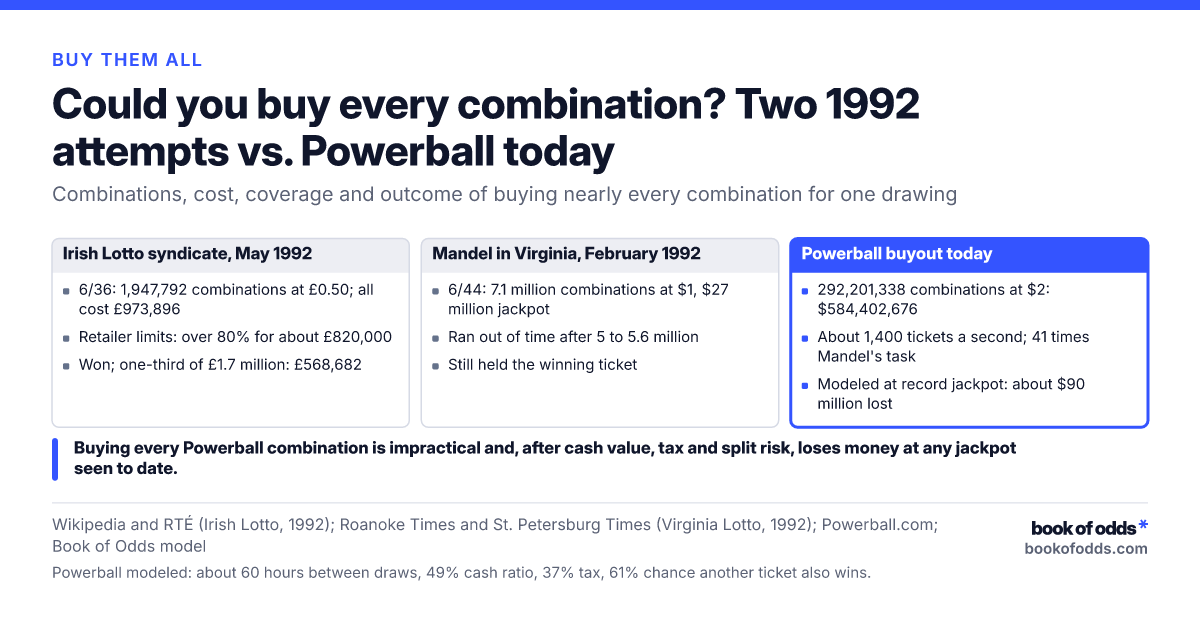
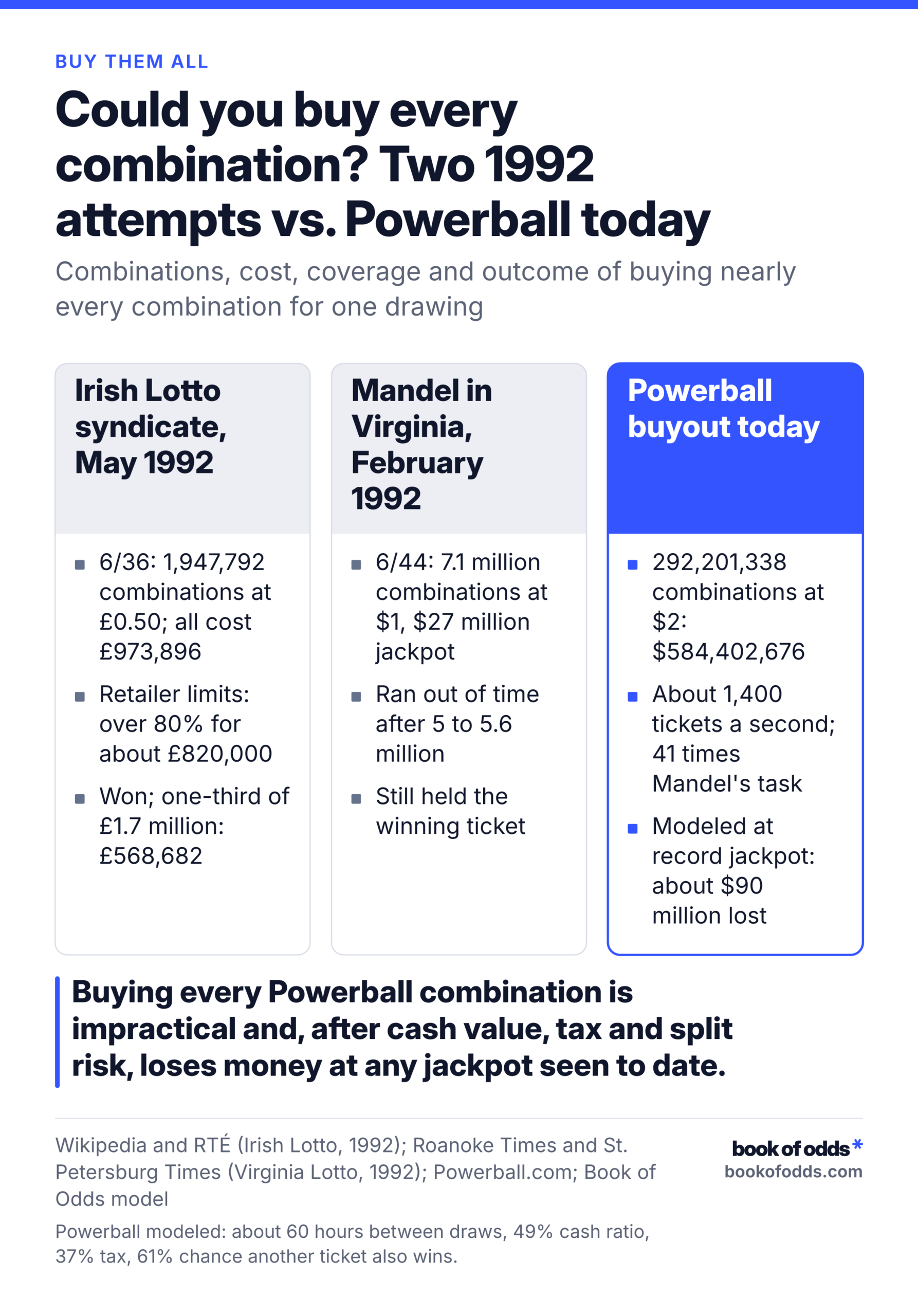
If one of the combinations must win, why not buy them all? Two syndicates tried versions of this in 1992.
In May 1992 Stefan Klincewicz’s syndicate went after the Irish 6/36 Lotto. It had 1,947,792 combinations at £0.50 each, so all of them cost £973,896. Retailer limits stopped full coverage, but the group bought over 80% of the combinations for an estimated £820,000 and held the winning numbers. The £1.7 million jackpot was shared three ways, so the syndicate took one-third, £568,682, plus smaller prizes. From August 1992 the Irish Lotto moved to a 6/39 game with jackpot odds of 1 in 3,262,623.
In February 1992 Stefan Mandel’s International Lotto Fund tried to buy all 7.1 million combinations of Virginia’s 6/44 Lotto at $1 each, chasing a $27 million jackpot. It ran out of time after 5 million to 5.6 million tickets but still held the winning ticket.
Powerball is a different animal. Every combination for one drawing costs $584,402,676. That means about 292 million tickets printed in the 2 to 3 days between drawings, roughly 1,400 tickets a second, and 41 times the combinations Mandel could not finish. Then comes the payout: the cash value at the record was about 49% of the advertised jackpot, the top federal tax rate is 37%, and at record sales our model expects a winning ticket to keep only about 0.653 of the jackpot once splits are counted. Even counting about $93.5 million in expected lower-tier prizes, our model puts a full buyout at the record jackpot at an expected loss of about $90 million. In our model, it loses money at every jackpot size we tested, up to the record.
Is a ticket, or Power Play, ever worth it?
View the data table
| Outcome | |
|---|---|
| $20 million jackpot | 0.3100 |
| $100 million jackpot (modeled sales level, not a recorded drawing) | 0.3800 |
| $263 million jackpot | 0.5200 |
| $2.04 billion record | 1.6900 |
| Record, if no one could share it (not real) | 2.4400 |
| Ticket price | 2 |
Expected value is the long-run average a ticket pays back. It is not what any one ticket returns: nearly every ticket returns nothing, and a very few return a lot. Think of it as the part of your $2 that comes back on average across a huge number of tickets.
Three things shrink the advertised jackpot before it reaches you. First, the headline number is an annuity paid over time, and the lump-sum cash option is smaller: $170.2 million cash for a $409 million jackpot in September 2026 (41.6%), and $997.6 million for the $2.04 billion record (48.9%). Second, taxes. The IRS requires 24% federal withholding when lottery winnings minus the ticket price are more than $5,000, but for tax year 2026 the top federal rate is 37%, applying to taxable income above $640,600 for single filers and heads of household ($768,700 for married couples filing jointly), so a jackpot winner owes about 37% on most of the prize. Third, sharing, from the model above.
Put those together and our model gives these expected values per $2 ticket:
- Non-jackpot prizes alone: about $0.32 before tax, or $0.29 after 37% tax on the $1 million tier.
- All prizes at a $20 million jackpot: about $0.31.
- At a $100 million jackpot: about $0.38. This case assumes a modeled sales level, not a recorded drawing.
- At a $263 million jackpot: about $0.52.
- At the $2.04 billion record: about $1.69.
The record ticket is the interesting one. Ignore sharing and it would have been worth about $2.44, more than its price. But with roughly 270 million other plays in that drawing, a winning ticket could expect to keep about 0.653 of the jackpot on average. Expected sharing is what pulls the record ticket below $2, and state taxes, which we did not model, could push it lower still. If you see a calculation that shows a profitable ticket at a giant jackpot, check whether it counted taxes and splitting. Bigger jackpots also sell more tickets, which raises the chance of sharing.
Power Play costs $1 more per play (in Idaho and Montana it is bundled, at a $3 minimum) and multiplies non-jackpot prizes. It never touches the jackpot odds. When the 10X multiplier is available, at jackpots of $150 million or less, the multiplier is 10x with odds of 1 in 43, 5x at 2 in 43, 4x at 3 in 43, 3x at 13 in 43 and 2x at 24 in 43. At bigger jackpots it is 5x, 4x, 3x or 2x at 2, 3, 13 and 24 in 42. A Match 5 with Power Play pays $2 million at any multiplier.
Our model puts the add-on’s expected extra prizes at about $0.50 per $1 when the 10X is available and about $0.46 when it is not, before tax. That is an expected loss of about half of every dollar.
If you play: what each choice changes
THE PLAN
How to play Powerball sensibly, if you play
Six decisions for one $2 play per drawing, each backed by lottery data or modeled expected value
Set a budget you can afford to lose
At $20 million to $263 million jackpots we modeled, a $2 ticket returns about $0.31 to $0.52 on average. Even the $2.04 billion record ticket was worth about $1.69 in our model.
Pool only if you accept sharing
Four friends with four different tickets get four times the chance of a payout, each a quarter the size, so expected return per dollar matches solo play.
Quick pick or self-pick: your call
About 70% of plays are quick picks (Minnesota Lottery), and about 70% of winners hold them (Minnesota Lottery) and roughly 80% of jackpot-winning tickets (MUSL via WTHR).
If you pick, go above 31 and skip patterns
Less popular numbers are likely to lower your chance of sharing a jackpot; they do not change your chance of winning it.
Add Power Play only as a priced extra
The $1 add-on returns about $0.46 to $0.50 in expected extra prizes and is only sold with a base play.
Skip hot/cold numbers, wheels and systems
Machines and ball sets are randomized before each drawing under independent auditors. A wheel only buys more $2 tickets.
Powerball.com; Minnesota Lottery; MUSL via WTHR; Rutgers University; Book of Odds model
Modeled EVs: lump-sum cash, 37% federal tax, split risk, no state tax. Power Play values pre-tax.
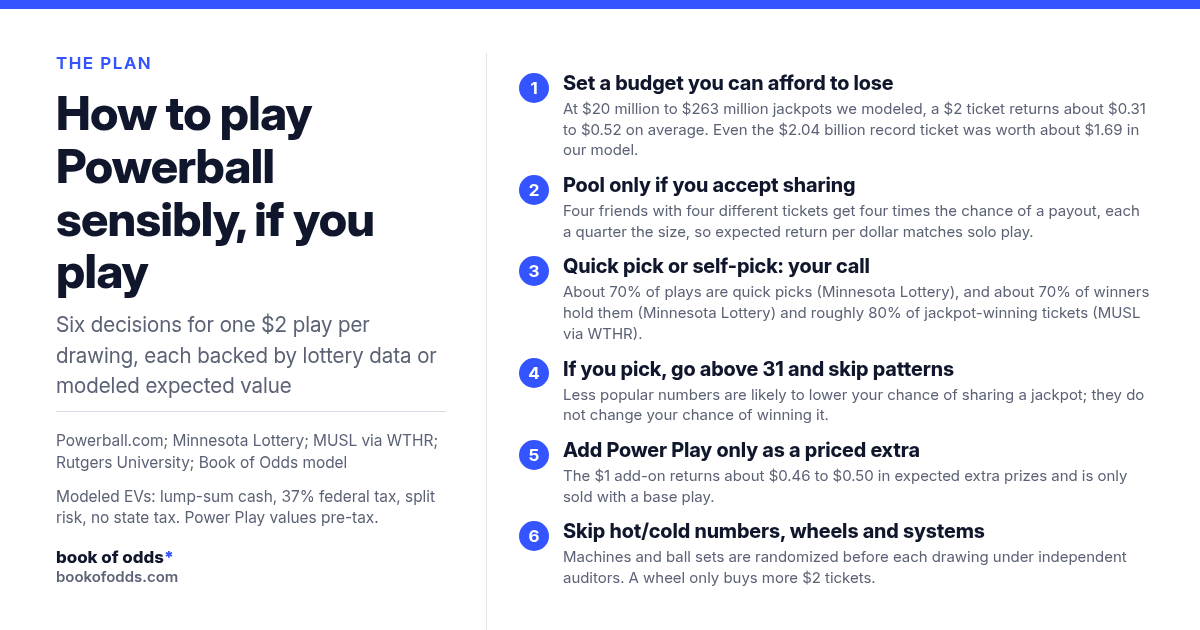
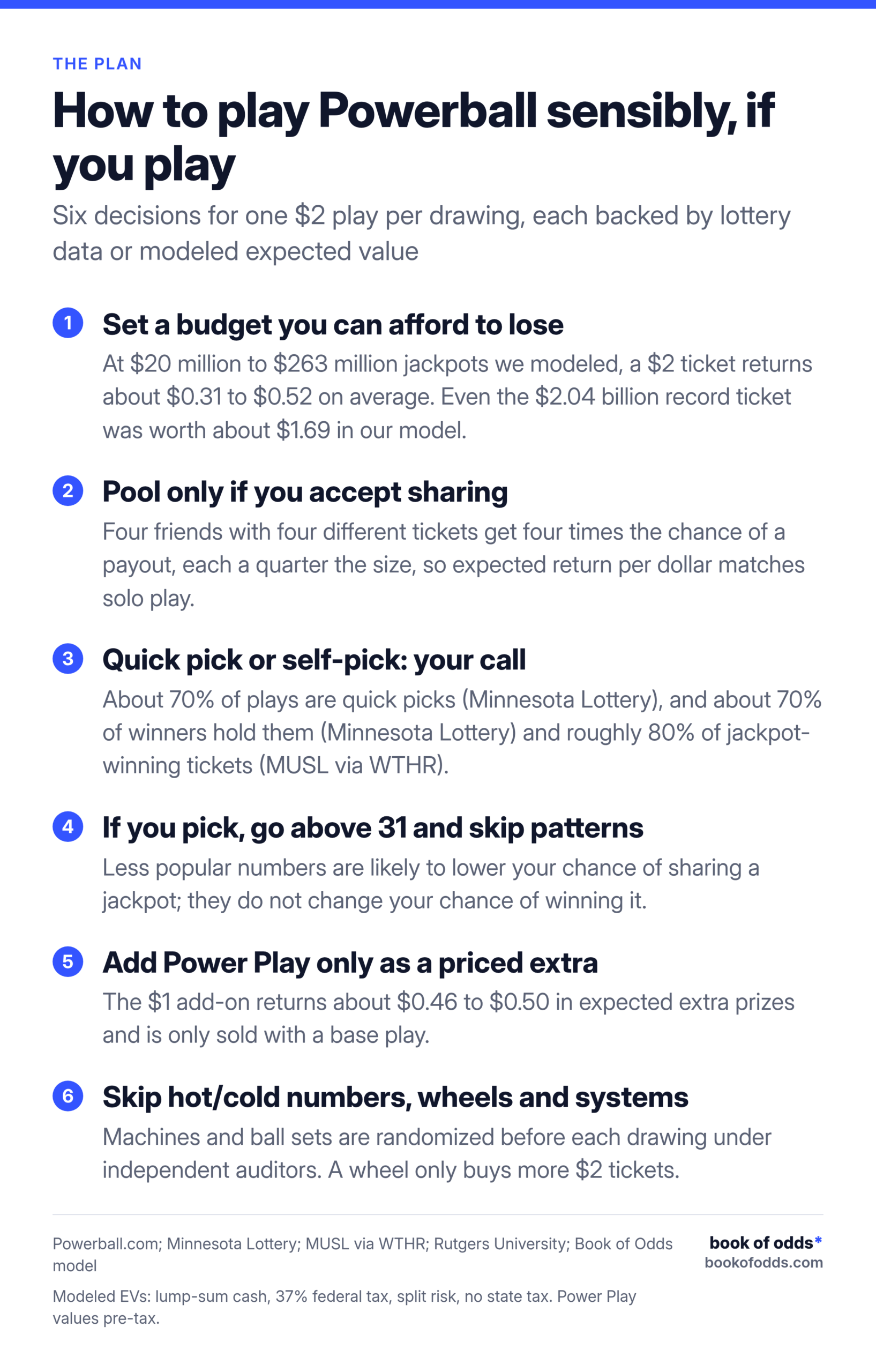
The graphic above sets out the choices. Here is the list, with the figure behind each item.
- Hot and cold numbers. Machines and ball sets are chosen at random before each drawing and checked under independent auditors, so past results do not steer the next one.
- Patterns on the slip. In the Dutch Lotto study, they appeared in 0.9% of entries versus 0.009% expected at random, so a pattern ticket keeps the same odds and raises your chance of sharing.
- Wheels and systems sold online. They buy combinations at $2 each, which you can do without paying for a system, or they do nothing.
- Waiting for a record jackpot to make the ticket worth it. Even the $2.04 billion record ticket was worth about $1.69 in our model, and at that level of sales a winning ticket had a modeled 61% chance that another ticket also won.
None of this says you shouldn’t play. It says a ticket is entertainment with a price tag, and now you know the price.