

Among US full-time college students in 2025, what share said they had used prescription stimulant medications without a medical prescription in the past year: about 3%, about 13% or about 30%?
About 3%. In the 2025 Monitoring the Future (MTF) panel survey, run by the University of Michigan and funded by the National Institute on Drug Abuse, 3.1% of US full-time college students said they had used stimulant medications nonmedically, which MTF defines as use without a medical prescription, in the past 12 months. That is a self-reported figure for students one to four years past high school, the typical college ages of 19 to 22.
Adderall is one prescription stimulant among several, and MTF’s 2025 results do not give a figure for Adderall by name, so the figures on this page are for prescription stimulants as a group.
College students and their peers
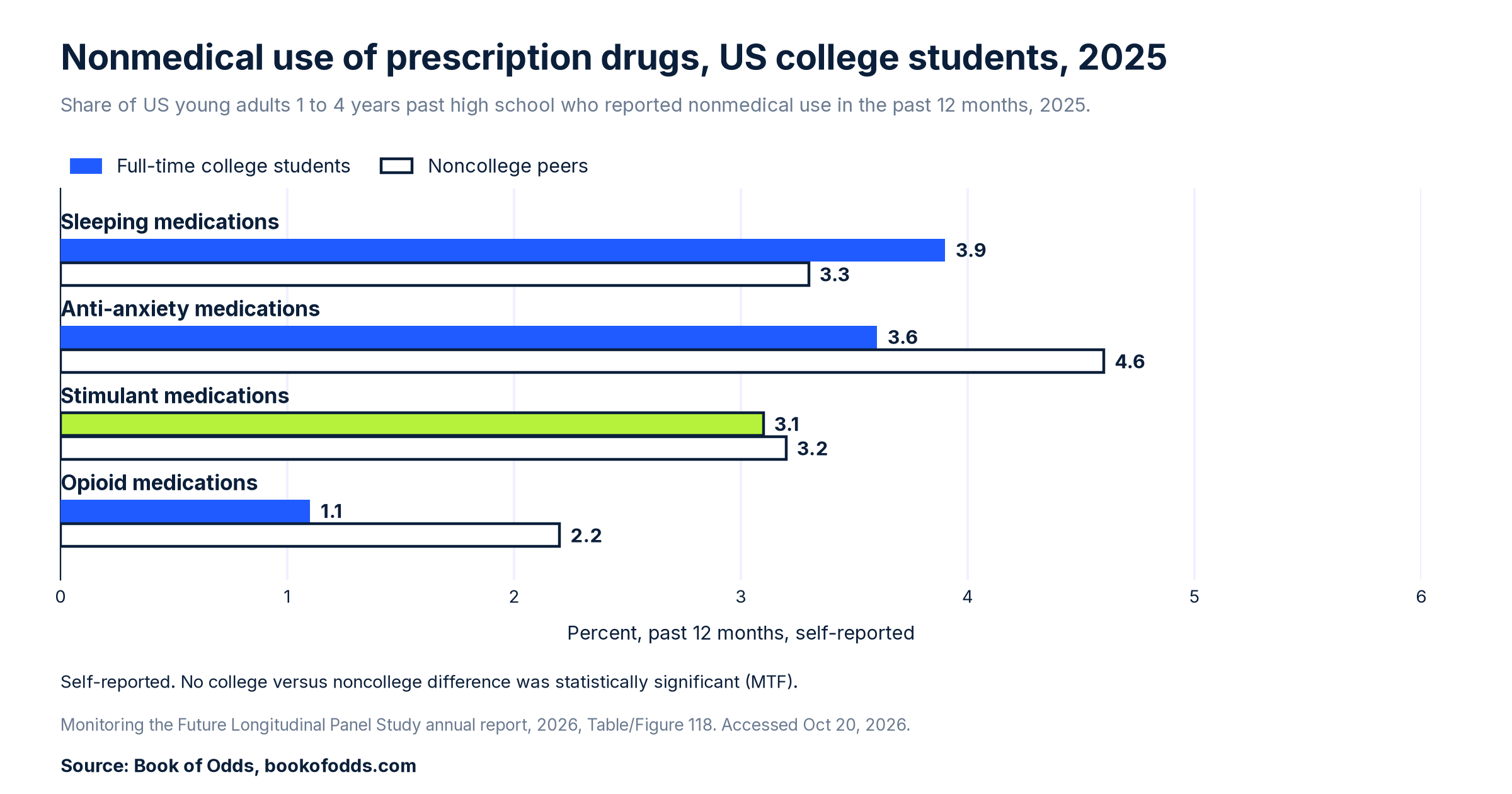
Young adults the same age who were not in college full time reported almost the same rate in 2025: 3.2%, against 3.1% for full-time college students. MTF found no significant difference between the two groups. MTF counts as college students those taking full-time courses at a two-year or four-year college; the noncollege group includes high school graduates who were not attending, were attending part time or had left college.
In the same 2025 college sample, past year nonmedical use of other prescription drugs was self-reported at 3.9% for sleeping medications, 3.6% for anti-anxiety medications and 1.1% for opioid medications, against 3.1% for stimulants. MTF found no significant college versus noncollege difference for any of them.

Across all young adults ages 19 to 30, MTF reports that self-reported nonmedical use of stimulant medications fell from 7.2% in 2015 and 6.3% in 2020 to 3.9% in 2025. That trend covers a wider age group than the college comparison above.
A second survey
A separate federal survey, SAMHSA’s National Survey on Drug Use and Health (NSDUH), measures “misuse of prescription stimulants” in the past year. In 2024, 2.8% of people in the US aged 18 to 25 reported it. That figure covers everyone in that age group, in college or not, and uses NSDUH’s own measure, so we do not compare it with MTF’s college figure.
What Adderall is
The FDA approved label describes Adderall as “mixed salts of a single entity amphetamine product”, indicated for attention deficit hyperactivity disorder (ADHD) and narcolepsy. It contains amphetamine, which federal regulations list as a Schedule II controlled substance.
Prescribed use is a separate measure. A CDC survey in October and November 2023 found that 6.0% of US adults, about 15.5 million people, reported a current ADHD diagnosis, and that about one third of them had taken a prescribed stimulant for it in the previous year. Those figures are self-reported and were not checked against medical records.
The risk the label names
The label’s boxed warning says Adderall “has a high potential for abuse and misuse, which can lead to the development of a substance use disorder, including addiction,” and that misuse and abuse of central nervous system stimulants “can result in overdose and death.”
Data limits
The MTF and NSDUH figures are self-reported answers about the past year, in 2025 and 2024. MTF follows people first surveyed in 12th grade, so it leaves out young adults who dropped out before 12th grade, which matters more for the noncollege group than for college students. The CDC ADHD figures come from online panels with low response rates, weighted to match the US adult population. “Nonmedical use”, “misuse” and a diagnosed substance use disorder are different measures, and none of the figures here counts addiction.
The short version
In 2025, 3.1% of US full-time college students told MTF they had used prescription stimulant medications nonmedically in the past year, about the same as their peers not in college.
SAMHSA’s National Helpline, free and confidential, 24/7: 1-800-662-4357 (TTY 1-800-487-4889).
Last checked: 2026-10-20, against the Monitoring the Future Longitudinal Panel Study annual report (2026), the 2024 NSDUH detailed tables, CDC’s MMWR on adult ADHD, the FDA label for Adderall on DailyMed and 21 CFR 1308.12. This article was machine-checked against the sources above and has not been expert-reviewed. Spotted an error or a newer public figure? Please tell us on our contact page with the article link and we will review it.
Sources
- S1 Patrick ME, Miech RA, O’Malley PM, Jager J, Jang JB. Monitoring the Future Longitudinal Panel Study annual report: National data on substance use among adults ages 19 to 65, 1976 to 2025. University of Michigan Institute for Social Research, July 2026. Chapter 4 and Tables/Figures 83 and 118. https://doi.org/10.7302/dspace/30276 . Accessed Oct 20, 2026.
- S2 SAMHSA, Results from the 2024 National Survey on Drug Use and Health: Detailed Tables, Table 1.48B. https://www.samhsa.gov/data/report/2024-nsduh-detailed-tables . Accessed Oct 20, 2026.
- S3 Staley BS, et al. Attention-Deficit/Hyperactivity Disorder Diagnosis, Treatment, and Telehealth Use in Adults (title shortened), National Center for Health Statistics Rapid Surveys System, United States, 2023. MMWR 2024;73(40):890 to 895. https://www.cdc.gov/mmwr/volumes/73/wr/mm7340a1.htm . Accessed Oct 20, 2026.
- S4 Adderall (dextroamphetamine saccharate, amphetamine aspartate, dextroamphetamine sulfate and amphetamine sulfate) tablets, prescribing information, DailyMed set id f22635fe-821d-4cde-aa12-419f8b53db81. https://dailymed.nlm.nih.gov/dailymed/drugInfo.cfm?setid=f22635fe-821d-4cde-aa12-419f8b53db81 . Accessed Oct 20, 2026.
- S5 21 CFR 1308.12, Schedule II, paragraph (d) Stimulants. https://www.ecfr.gov/current/title-21/section-1308.12 . Accessed Oct 20, 2026.
- S6 SAMHSA, National Helpline. https://www.samhsa.gov/find-help/helplines/national-helpline . Accessed Oct 20, 2026.